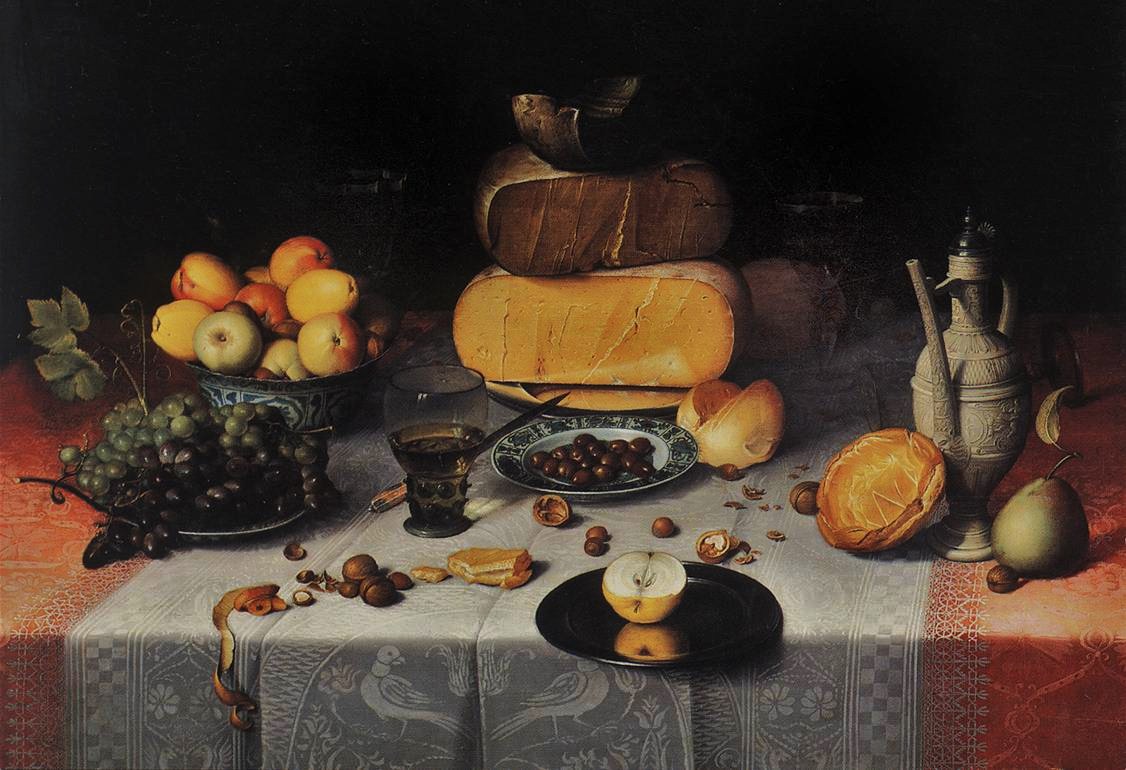
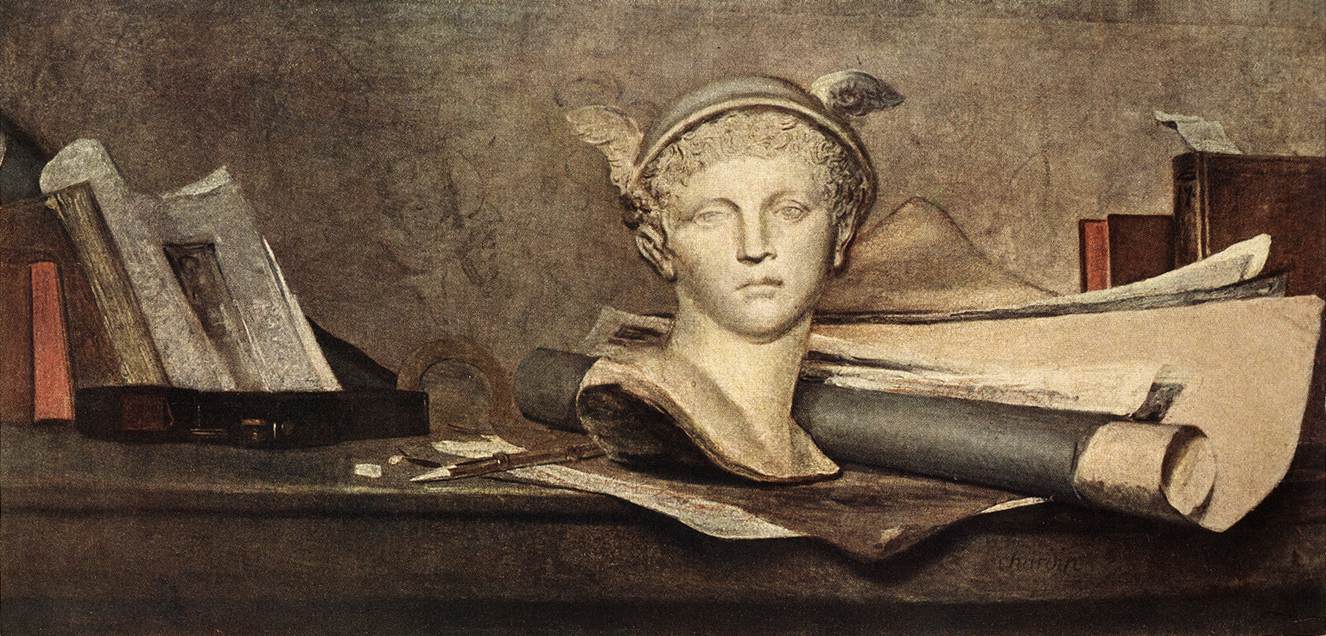
Of this particular genre of
painting there is a certain element of pathos which should be understood. There is a touch of sadness to be found in a
still life. Here is a painting showing
no action or event taking place; rather it pictures an inanimate, quiet, and
often lifeless world. There are almost
never any people in the paintings. The
scene is set in a lonely room, often dark and often obscured from full view. How far back the room goes we do not know; we
don't even know where we are, really.
Dreamy, cloudy, and almost mystical, it is no wonder that Baroque still
lifes generated a symbolic connection with religious paintings. This period and genre of art could fill an
entire life's work of study and research—and a very interesting study that
would be—but we will stop here to move on.
Showing posts with label Still Lifes. Show all posts
Friday, October 4, 2013
Tuesday, October 1, 2013
Still Life (pt. 7)
In order to lend more thoroughness
to our examination of this genre, we will look at one painting, at least, in
detail. This painting, then, is called
Still Life with Parrots, created by Jan Davidsz de Heem during the late
1640s. (By the way, so many people crack
jokes about titles such as "Still Life with Parrots" for its apparent
lack of originality. It is important to
remember that many paintings were produced without being given distinct titles,
and ones such as this are probably names bestowed on the painting by patrons,
critics, or other people, not the
artist).
What do we see here? The painting contains a lavish variety of foods,
ornate utensils, and a pair of parrots around an extravagantly prepared
table. Everything is expensive:
expensive silverware, exotic food, expensive parrots, etc. Nevertheless, it doesn't matter how enviable
these objects are; the fruit is going to go bad if it is left around and not
eaten. The tablecloth appears to be
falling off the table, so perhaps the food will simply fall onto the floor
before it goes bad anyway. There is an
extraordinary wealth of objects in this painting, but they are all being
ignored. Insects (specifically
butterflies, which do not live very long) have their pick at the goods, and,
somewhat randomly, there are a couple of parrots just hanging out amidst the
scene. Do you think the parrots are
bickering over the food? The one on top
looks down slyly from its perch and holds something, an unidentified object, in
its beak. Perhaps these animals know
something we don't.
Because the objects are so
expensive and rare and because they are so brightly colored, the painting becomes
something of a "visual feast" to the viewer. The dark curtain in the back contrasts with
the bright food, and everything in the work draws your eye across the canvas in
a curvy line. There is an "s"
curve: starting at the lower right corner, the objects sway upwards in the line
of a letter S, leading your eye through the entirety of the work. This is a masterful way to construct a
painting, because our eye is able to absorb all the incredible imagery of the
work in a flowing motion that is almost as graceful as the delicate
brushstrokes de Heem used to paint it.
The food, as I said, is all left
out to rot or be eaten by the animals, indicating a thematic focus on the
mortality of this world, but the food items also serve to connote spiritual
teachings. The lemon has been peeled
away to demonstrate the stretching out of this earthly life's term to its last
bits. The wine reminds us of Christ's
last supper with His disciples. The
expensive, exotic shells, representations of the economic vivacity during this
time, also bring the viewer back to fundamental ideas about vanity and the
futility of riches, the vanitas theme epitomized. If you take to examining still lifes to any
great quantity you will soon become familiar with the exhaustive list of symbolic
imagery conveying religious ideals or stories, often sort of random connections
like a certain flower representing the Virgin Mary and things of this nature.
The beauty is stark in this
painting, with vivid colors and an abundance of items set on the stage like a
collage. Everything about it shouts of
the vibrant majesty of all that there is in life to enjoy—it's just that the
artist makes the point to his viewers that these things don't last very long. The food will rot; the birds will fly away;
the black curtain will close on the scene.
Death is the pervading, imminent truth in most of these paintings. It oozes from the canvas as baldly as the
glistening oils themselves, shiny, cracking, breaking down through the passages
of time, hanging somewhere on a museum gallery wall. Says the king in Shakespeare's Richard II: "I wasted time, and now
doth time waste me."
What of the setting? Past the table, a good three-quarters of the
background is covered by a large, impending curtain of black. That dark, ominous veil comes over the
painting like a shroud, again probably indicating the vanitas message of imminent
mortality, but there is a patch of openness beyond it as well. We see a kind of porch area with a Doric
column, and it's overlooking a grand view of the sea and a bright horizon over
it. Many miles away, this area of the
work shows itself as a very small portion of the canvas, a few dots on the
grand surface that extends almost as large as 5' x 4'. Nearer to the viewer and the scene is a sky
of tempestuous and foreboding clouds, dark, threatening, and implying the
oncoming of a storm. You may have
thought the curtain was bleak with its black undertones of death, but the scene
behind it appears just as grim. However,
de Heem adds the tiny bit of light almost in the center of the painting, next
to the column: the bright horizon line above the sea that can either denote the
hopeful rising of the sun on the dawn of a new day or the descending of the sun
to foretell the arrival of night. The
meaning remains ambiguous.
Thursday, September 19, 2013
Still Life (pt. 6)
One of the most prevalent themes
became known by the Latin word "vanitas," from which we derive the
English word "vanity." A
vanitas still life is an image in which all objects symbolize the theme of the
transience of life. That is a very important
phrase: "the transience of life."
Life is not going to go on forever; it will end (and this bears implicit
religious connotations as well—to remind viewers to live religiously in order
to go to Heaven). The objects are all
placed out on display for us, but they are inanimate, robbed of life, still.
No matter how ornate, expensive, desirable, or beautiful these objects
might be, they will never be moved from the eternal position in which they lay
on the canvas, and we as viewers of the paintings can never remove them. Often we see paintings of fruits and
extravagant foods laid out on a table to be eaten, and yet no one is around to
eat. What a shame to leave the fruit there
unattended—it will surely go bad!
"The grass withers and the flower fades," says the vanitas
message of the painting, "but the Word of the Lord is forever"—the
message of His truth and the inevitable reality of death are as enduring as the
works of art themselves.
Even more solemnly are placed in
still lifes evidences of human life that has left and left in a hurry. This is the meaning behind the tipped glass
that appears in so many artworks of this genre.
It implies that the person handling the object was suddenly called
away—no one knows why. A snuffed candle,
objects in disarray, half-peeled fruit, and tablecloth that is falling off the
table all show that the host or hostess left before they could finish their
tasks, and that they were called away too soon by an incontrovertible call
(perhaps the call of death when its time has come). Jewelry no longer has an owner, books no
longer have a reader, no matter how expensive or important. The people in these paintings are simply gone
and leave behind only remnants of things that they cannot take with them. You'll notice many times the flowers in these
paintings conceal small insects. In a
kind of post-apocalyptic tone, many painters decided to show Nature falling
back unto its own after the people have gone.
The bugs are free to eat away at the fruits and flowers. Also it was a chance for artists to
demonstrate their skill in filling their subject with endlessly interesting
finds that can be altogether new to the viewer even after years of owning
it. In my own experience from working at
a museum, I have been allowed the distinct opportunity of getting to spend
countless hours with paintings such as these.
Many times I would be called on to spend the entire day in the still
life galleries. There are often so many
hidden things in a still life that only come out from long hours spent alone in
a room, staring at them. To spot the
insects in the paintings became something of a game among us.
Monday, September 16, 2013
Still Life (pt. 5)
It is no coincidence that some
objects appear more frequently in Dutch still life paintings than others during
the Baroque period. We see lots of
paintings that include fruit, fancy silverware, flowers, candles, books,
jewelry, musical instruments, and that ominous skull that keeps
reappearing. What does it all mean? I will examine a particular still life in
detail to provide the model for inspection into this genre, but it will be
useful to first offer a bit of general overview.
Putting aside the purely material
intentions of artists who were advertising trade with the Eastern world and a
predominant fixation on tulips, these paintings do carry a prevalent religious
theme. Knowing the Protestant minimalist
tendencies of Genre paintings and nature landscapes, a still life is a
relatively simple work of art to look at.
The humility of man (and more specifically the humility of the artist)
is being expressed through this latent simplicity, but the underscoring themes
that reside beneath the surface of the work demonstrate the bent of the artist
toward the deep, personal connection with God, profound philosophical thoughts,
and the innermost sincerity of human emotion.
Compare this to Rubens' Raising of the Cross, an elaborate, huge
painting that featured heavy action and drama with bulky figures and flowing,
multicolored robes. A still life, on the
other hand, features the simple, Protestant mindset of a table set with certain
objects, objects to be celebrated on one level for their sheer beauty and on a
subliminal level for their deeper, philosophical connotations. Objects, as I said, become symbols,
representing abstract concepts of life, death, God, the universe, and mankind.
Thursday, September 12, 2013
Still Life (pt. 4)
Early on, during the Baroque period
which we are looking at now, objects presented in a still life carried the
distinct connotation of being the personal property of the artist. Whatever you saw in a painting he owned, and
that turned into a kind of status symbol.
No other genre of painting so conveniently provided a way to show off
all of your stuff to the wealthy patrons purchasing works of art at this
time. It may even bring you more
customers if you are suddenly thought to be both talented and wealthy.
Dutch still life paintings did
this; they celebrated the abundance of wealth that trade brought to Flanders
and the Netherlands. This is why many of
the objects you see in these Dutch paintings (some of them aren't) are exotic,
imported goods from other countries. The
market was flourishing during this time.
It was also the golden age of
horticulture. Tulips especially priced
high on the market as exotic finery more desired at that time than
jewelry. They were first introduced to
the Dutch from Constantinople. The word
"tulip" is itself a Turkish word, indicating a turban. Holland society quickly developed a demand
that soon grew broader than the supply, leading to a historic display of
exaggerated economic inflation. The
Dutch people's obsession with tulips literally became known as
"tulipmania."
Here is a source that can better
explain it than I can. This short
article on tulipmania was taken from the 2012-2013 exhibition called
"Significant Objects," from the Norton Simon Museum in Pasadena,
California:
In a
century characterized by inflation, the prices fetched by the tulips through
sales and trade were constantly on the rise.
People eager to turn a profit flocked to the market to trade tulip
bulbs. Many gambled their homes, farm
animals or other goods in anticipation of fortune to be made on tulip
sales. The intensity of this speculation
appeared to operate outside the laws of common sense. The phenomenon has been aptly named
"tulipmania."
Particular
tulips brought extraordinary sums. The Semper Augustus, for example, was a rare
tulip, characterized by blood-red flames and streaks on its white petals. It sold for 1,000 guilders in 1623. By 1637, just before the crash of the market,
its price reached 10,000 guilders. (To
compare, the annual wage of a skilled laborer in Holland around this time was
200 to 400 guilders; a large house alongside a canal cost around 6,000 guilders).
In
1637, the combination of rumors about a failing market, and the fact that
buyers and sellers could no longer transact business at such inflated prices,
set off a selling spree. Within months,
the market for tulips collapsed.
Investors suffered heavy losses, and many went bankrupt. Today, historians view this widespread market
crash as "the first great speculation crisis of modern capitalism.
So.
A personal practicing exercise for artists, a display of wealth to
viewers, an indiscriminate way to employ new artistic techniques collectively,
a celebration of the successful trading industry, a cathartic expression of
your tulip fetish: these are all functions that still life paintings served in
the Netherlands during the Baroque period.
But apart from these mostly material purposes, still life art served a
deeper role in communicating metaphysical sub-meaning and religious truth. There is a lot of hidden meaning in most
Dutch still life paintings; and if you thought the Renaissance imagery was difficult
to follow, hold onto your berets.
Monday, September 9, 2013
Still Life (pt. 3)
As for the viewer, still lifes give
an excellent opportunity to see into the mind of the painter. How is this?
In a portrait, a landscape, historical scene, biblical scene, or any
other genre of painting, the subject is, to a certain extent, already latent
and manifest to the artist before he begins to paint it. But with the still life, the artist has selected
himself what is to be painted.
Everything we see within the frame is the artist's personal choice of
objects. When we see flowers, we can
tell that artist has an appreciation for beauty and nature; when we see books,
we can assume the artist is learned or probably well-read; when we see a skull,
we come to different conclusions; and so on.
The images we see are not purposeless drawings; they represent
something, either directly or indirectly, about the artist himself.
Many times the artist intentionally
picks items to convey a particular message to his audience, not about himself
but something else. We will dissect this
in greater detail later. Unlike other
kinds of paintings—landscapes, portraits, historical scenes, and so on—these
works come solely from the artist's imagination as the scene is a created
display of items handpicked by the painter, and these items begin to refer to
ideas, making the assemblage of objects in a still life like a kind of
narrative story, essay, or sermon. The
eye "reads" from left to right, after all, and the arrangement of
objects is sometimes so precise that it almost forms something of a written
text.
There can be many mysteries in a
still life that at first hit the viewer with their stark visibility but then
resonate back in the deeper sense only after careful study and thought.
Thursday, September 5, 2013
Still Life (pt. 2)
Artists do use still life painting
to polish their expertise. Many of the
most stunning paintings are still lifes.
The artist, as I said, has all the time in the world to painstakingly
execute the minutest of brush strokes, leading to a stylistic element called
photorealism. This was known as trompe l'œil, which is French for
"fooling the eye." Linear
perspective, chiaroscuro, tenebrism—all of the artistic elements we have looked
at to date come into play here, making still lifes among the most dynamic
paintings in all of art history to observe.
But, for me at least, there is something strange and almost unsettling
about the realism of images that hangs inside a frame on a wall. The objects are so close, poised on whatever
cabinet surface or tablecloth, we feel we could almost stretch out our hand and
touch it. Why is that? Approximately two hundred years early, I'll
ask the question: why must paintings look real?
(Centuries later, artists will seriously contemplate this in their
works). What do you think is the point
of making an inanimate object—that has no life of its own and that is painted
two-dimensionally on a flat canvas—real?
Tuesday, August 27, 2013
Still Life (pt. 1)
The Baroque age in art also saw the
surge of the Still Life. A still life is
a painting of an arrangement of inanimate objects usually showcased on a
tabletop or other flat surface in an enclosed space. We have all seen paintings like this before
and may have thought them simple or even boring enough, but "surely all
this is not without meaning."
In this case, the
"subject" is whatever is pictured in the image. The subject of a still life can be a glass
cup, a vase of flowers, a book, a skull, or (most popularly) an assortment of
objects. To the untrained eye these
items can at first appear random, but as you will see, some still life paintings
ambitiously tackle more subject matter, artistic form, color scheme, and
picturesque detail than landscapes or historical paintings.
Still lifes—and I distinguish: the
plural of "still life" is not
"still lives"—can offer a unique blend of genres for both artist and
viewer. By simply painting immobile
objects on a stationary table or drawer-top, the artist can have the chance of
practicing his trade on something decidedly easier than, say, a portrait, where
a live sitter is involved (who coughs, moves, easily becomes bored, and can
distract the painter from his duty). In
the case of a still life, the objects are all completely motionless; the artist
can take all day, or even a year—it matters not: the objects will still be
there.
Subscribe to:
Comments (Atom)