Showing posts with label Northern European Renaissance. Show all posts

Monday, April 22, 2013

Northern European Renaissance (pt. 15)


Henry VIII, as you know, is somewhat infamous for having many wives (six).  After his third wife died, the king was in search for a bride and was considering Anne of Cleaves, a German noblewoman.  The king asked Holbein to paint a portrait of Anne to bring back to him and show him whether or not she was beautiful enough to be his bride.  Sir Thomas Cromwell, the king's chief minister, instructed Holbein to paint a beautiful portrait of Anne because her marriage to the king was desired; yet Holbein also had to paint Anne as realistically as possible, for such were the king's orders.
When the artist visited the Lady Anne, she turned out to be dull, plain, and uneducated.  And so Hans Holbein was faced with a challenge: he had to paint Anne as beautiful but also had to show her plainness to the king.  The finished product...
Henry VIII married Anne but soon became enraged by her dull character, and the two were divorced only months later.  The artist, however, was never punished.

Friday, April 19, 2013

Northern European Renaissance (pt. 14)


During this time we also see more expertise in the area of optical illusion.  This totally random painting by Hans Holbein (the Younger), called The Ambassadors, features such an illusion.
Okay, here's what you got to do: turn your computer monitor to the left, so that you're looking at it sideways from the far right end.  Now, look at the bottom of the painting from that side view.  (Oooh!  Creepy, isn't it!)  So, by their attire and by objects placed on the table between them, we surmise that these are two wealthy, educated men of considerable knowledge and talent.  But the hidden message is...they, too, will die.  (This kind of theme will come back in just a little bit).
Hans Holbein also painted this portrait of Edward the VI as a Child.
It was a New Year's gift in 1539 to King Henry VIII (Edward was the king's 14-month old son and heir).  The child looks very dignified, doesn't he?  He's ready to rule.  Actually, he was crowned king at the age of nine, and he died of illness at age fifteen.  The text below him is a Latin verse commending virtue.  Can anybody read it?

Thursday, April 18, 2013

Northern European Renaissance (pt. 13)


Rogier van der Weyden is another key name of the Northern European Renaissance.  He, like so many others, usually painted images with religious themes.  Here is his Descent from the Cross panel.
This, like Giotto's Pietà, almost looks like a stage picture from a play; each character strikes a different pose and indicates an expression of sorrow over the death of Christ.  Mary's and Jesus' pose are identical, each of their bodies curving in an "S" shape.  Mary's and Christ's hands almost touch but do not—like Michelangelo's Creation of Adam, except no effort is being put forth here because one character is dead and the other passed out unconscious.  Mary's other hand rests next to a skull.
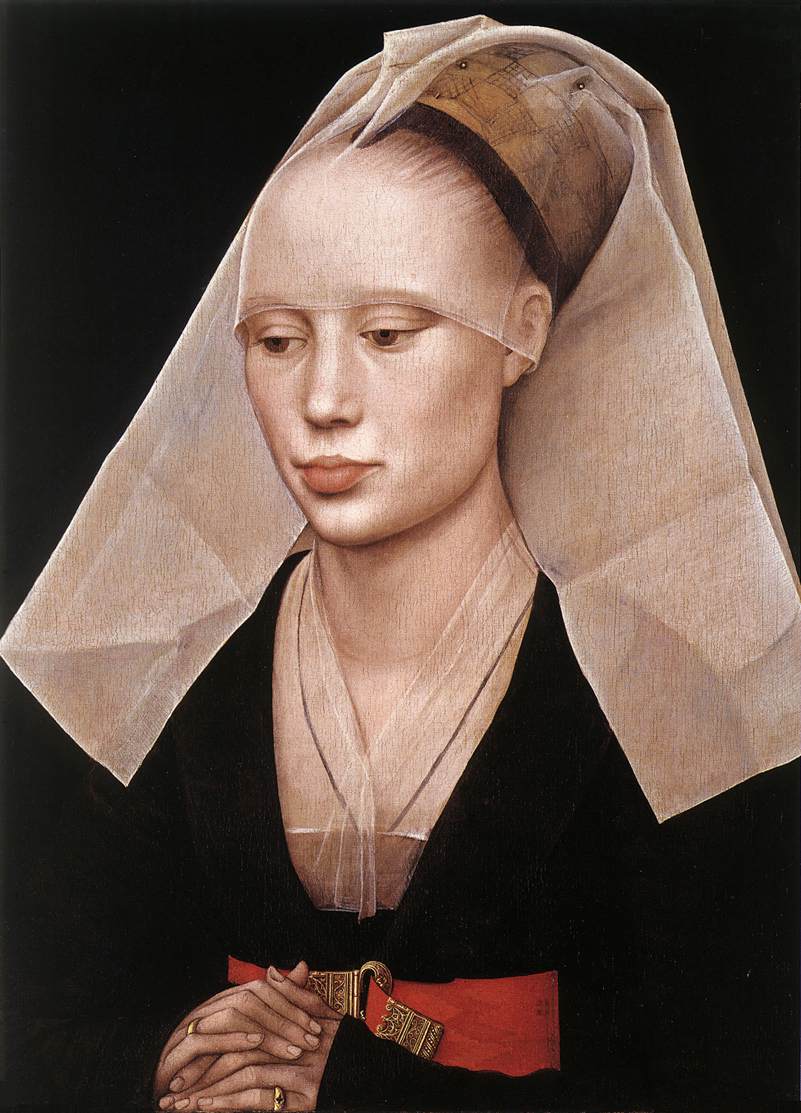
Van der Weyden also specialized in portraits.  Here is his Portrait of a Lady, which displays the ideal submissive woman of the time.  Once again, this is propaganda.
There is very little color or excitement in this painting, eh?  This woman does not wear much jewelry (an indication that she is humble), and yet the belt buckle and ring at the bottom indicate that she is wealthy.  She wears mournful black and pure white.  She looks down submissively.  Her hands are folded together.  This is all propaganda for this woman, what would have been intended as an advertisement for her to possible suitors.  Would you want to marry this woman?

Monday, April 15, 2013

Northern European Renaissance (pt. 12)


Around the same time as the Peasant Wedding, Bruegel also painted an expressly religious painting called the Parable of the Blind, an allegorical painting showing five blind beggars walking in a line toward a pit, where the sixth beggar has already fallen.
The painting alludes to the biblical parable by using symbolism.  The pathway represents the road to eternal suffering, at the end of which lies a ditch (Hell).  The blind follow their blind guide and are doomed to make the same error when he falls into the pit.  A church is seen in the distance, the spire framed by two trees, but the blind have gone their own way.  The second man even wears a cross necklace, but he will fall too (not even the pious can save themselves).
Bruegel painted each of the blind men accurately for a more lifelike appearance—each of their faces communicates a different emotion, from confusion to fear.  Bruegel also made a study of vision impairments before painting this, and you'll notice that each man in the Parable of the Blind has a specific form of blindness.  He wanted to paint it as accurately and realistically as possible.

Wednesday, April 10, 2013

Northern European Renaissance (pt. 11)


I said there was an elevation of the middle class during this time.  We see it again with this painting by Pieter Bruegel called the Peasant Wedding, which shows just that.
There is absolutely nothing religious about this painting; it is a scene from everyday life (like Anguissola's Game of Chess).  What's more, this isn't even a painting of aristocrats or rulers; it's a painting of a group of lowly peasants feasting on pies and ale.  No Madonna, no Child, no host of angels; it's just a bunch of unnamed peasants.  This is Realism—not just the realistic style of making figures that look lifelike, but the entire concept of Realism, that art form attempting to present all aspects of life accurately.  Slowly, art will move away from the religious (though never entirely).

Saturday, April 6, 2013

Northern European Renaissance (pt. 10)


This is the Portinari Altarpiece by Hugo van der Goes.
This time the patrons appear on both left and right panels, surrounding the characters of the center panel, which shows the nativity.  A number of angels surround the baby Jesus.  Mary is wearing blue this time; she makes a heart shape with her hands.  Columbine flowers are at the bottom of the painting (they are a symbol for Mary, though I don't know why).  There is both a bull and a donkey in the stable to the left, the first looking ahead at the historic birth of Christ, the second not even minding it—showing that both the righteous man (bull) and the ass (donkey) can claim to be "near" to God.  Even so, in this painting there are both heavenly angels and lowly shepherds present to see Christ born, but van der Goes does not show the shepherds in a negative light like the donkey.  In fact, the shepherds are the liveliest bunch of the whole party, clapping their hands, smiling, and showing the most personality.  The faith of the lowly shepherds would seem to be the most vivacious ("blessed are the poor in spirit").

Thursday, April 4, 2013

Northern European Renaissance (pt. 9)


Dürer was a German artist who went to Italy to study the work of the Renaissance artists there.  He studied perspective and the theory of proportions.  He became most famous for his engraved images in metal plates via intaglio printmaking, which is a process in which ink is forced to fill lines cut into metal surface.  His famous work of the Knight, Death, and the Devil is an engraving made in 1513.
The figures in this picture are reminiscent of the strange creatures in Northern Gothic paintings, as Dürer liked to combine his own ideas with Renaissance ideas.  It shows a stalwart Christian soldier making his way to the heavenly Jerusalem (which we can see on the hilltop), accompanied by a loyal dog.  Death is the scary old man holding up the hourglass (indicating that his time is running out), and the Devil is a weird, almost silly-looking animal-like thing (Dürer here makes fun of Satan).
Dürer also made woodcuts—prints made from a design raised in relief on a wooden block.  The Four Horsemen of the Apocalypse is a woodcut which he engraved.
This image was inspired by Revelation 6:1-8, where the Apostle John describes four horsemen to come during the End Times.  (From closest to farthest in the engraving I list them).  The rider on a sickly, pale horse is death; the rider holding a set of scales (weights) on a black horse is plague and famine; the rider carrying a sword on a red horse is war; the rider on a white horse is conquest (though Dürer makes a mistake in that in the biblical account the rider has a bow but no arrow).

Tuesday, April 2, 2013

Northern European Renaissance (pt. 8)


Though Italy had become the essential place for Renaissance art, the monarchs in Europe helped to spread the Renaissance style, and artists moved around and spread their ideas.  German Renaissance artists include Matthias Grünewald and Albrecht Dürer.
Grünewald preferred the dreams and visions of Gothic art.  His painting The Small Crucifixion provided a visual sermon.  It shows the agony and pain of Christ's death.  Christ's body is sickly yellow against a black backdrop.  The whole painting expresses intense pain and sorrow.  Some people were said to have fainted upon seeing it.


Wednesday, March 13, 2013

Northern European Renaissance (pt. 7)


Giovanni Arnolfini was a rich Italian merchant who lived in Flanders and made a living off selling silk; he may have also been a banker.  In 1434 he found an artist (Jan van Eyck) to paint his wedding, and the resulting work of art, one of the most famous in art history, was the Arnolfini Wedding Portrait.
The painting shows two people standing side by side in a well-furnished room.  The man dressed in black is Giovanni Arnolfini, and the woman in green is his bride.  There is an extensive list of symbols in the painting, each meticulously painted with unparalleled precision (unparalleled then and unparalleled now).  Giovanni raises his right hand as if he is saying an oath (perhaps this is the moment when the couple are making their marriage vows).  The bride places her right hand in his left.  Giovanni's expensive fur coat demonstrates his wealth (so part of how they wanted to be remembered was as being rich).  The couple have removed their sandals as a sign that a holy event is taking place (they are also very contrite and devout).  There are prayer beads hanging on the wall behind them.  The man is next to the window (implying that his place is out in the working world); the woman is next to the bed (implying that her place is in the home).  The broom hanging in the back implies that it will be a tidy household.  The bride's "ruffled" dress (I know she looks pregnant, but it's supposed to just be ruffled) implies they will have a "fruitful" marriage.  (By the way, notice that this marriage is taking place in a bedroom?)  On the bedpost is a carving of St. Margaret, the patron saint of childbirth.  And the dog between the two is a symbol of loyalty (dogs are usually a symbol of loyalty).  On the wall we see a Latin inscription that reads "Jan van Eyck was here."  Haha, no he wasn't tagging his own painting—it was to signify that the artist was a witness to the marriage vows.  Below the inscription is a mirror, which shows the reflection of the room, the backs of Giovanni and his bride, and two people standing in the doorway.  These two people face the bride and groom as they exchange their vows.  One is the priest marrying them; the other person is you, the viewer (want to look at yourself? haha).
This is a close up of just the mirror.  Now do you see how detailed this painter was?  Around the mirror are tiny pictures of Christ's life.  Incredibly, Van Eyck was able to use such microscopic brushstrokes to add such detail to his paintings.  Lastly, a single burning candle on the chandelier overhead is the symbol of God's presence at the wedding.

Sunday, March 10, 2013

Northern European Renaissance (pt. 6)


Van Eyck's painting of the Adoration of the Lamb displays the artist's ability to paint detail.  It contains angels, saints, and earthly worshippers moving through a green valley toward a sacrificial altar.
The lamb on the altar is a symbol for Christ (the Lamb of God), and the chalice collecting the Lamb's blood represents the Holy Grail.  The fountain in the foreground is the fountain of life.  The painting's symbolism conveys the meaning that the fountain of life (eternal life) is possible through Christ's sacrifice on the cross.  The Lamb is the obvious center of interest.  All the groups in the painting are angled and facing toward the Lamb, and some even move toward Him.  The artist took the time to paint each face—lots of detail.

Saturday, March 9, 2013

Northern European Renaissance (pt. 5)


The artist credited with inventing the techniques of oil painting was the Flemish master Jan van Eyck.
Above is van Eyck's oil painting of Saint Jerome in His Study.  Van Eyck far surpassed both Campin and Bosch in attention to detail.  The deep green color of the tablecloth, the deep red color of the cloak, and the deep blue color of the drapery all complement each other.  Look at the detail in the paper, wool, leather, and glass.
Here is the prime example of how patrons made not-so-subtle appearances in artwork around this time.
This is another work by Jan van Eyck.  The man on the left is the patron, Chancellor Rolin, who is bowing humbly before a Bible, with his hands folded in worship.  On the right are Mary (wearing red…again) and the baby Jesus sitting on her lap.  Jesus sits upright and pronounces blessing on the chancellor (a gesture with the index and middle fingers) while Mary is being crowned as the Queen of Heaven by an angel overhead.  But they are not in Heaven.  They are actually in the chancellor's house.  Fine place for Mary to be crowned Queen of Heaven, in the private residence of some guy in Flanders, but this is what the patron commissioned.  By the way, look at the fabulously designed tiles, the lines of which all help in creating the illusion of one-point perspective.
There is something a little more sinister in this painting, depending on how you look at it.  Remember the relief of Nike Adjusting Her Sandal back in Ancient Greece?  It took one of the Greek gods and lowered her to being construed as clumsy and quite human.  Now look at this painting again and notice that the Virgin Mary is alone with the chancellor in his private home, in what appears to be an upper room (usually the more intimate of rooms).  It begs the question: what is the Virgin doing there?

Wednesday, March 6, 2013

Northern European Renaissance (pt. 4)


A huge artist of the Northern European Renaissance was the Flemish painter Hieronymus Bosch.  His attention to detail was equally impressive.  Here is his painting entitled Death and the Miser, painted around 1485-1490.
There is a lot going on in this painting.  First of all, if you don't know what the word "miser" means, go look it up; it's a great word.  The miser lies on his deathbed here, torn between good and evil.  Death, the skeleton entering in through the door, ready to strike with his sharp arrow, indicates that his time is almost up.  The angel next to him urges him to place his trust in Christ, pointing to the crucifix in the window.  The miser is about to look at the crucifix but is also reaching for the money being offered him by a demon.  Indeed, there are a lot of little demons running around in this picture, signifying that this man is well on his way to joining the rest of the demons in Hell because of his wicked lifestyle.  We see some of his wicked lifestyle played out for us.  At the foot of the miser's bed is a scene from his past.  We see the miser himself, dressed in green (the color of greed), holding onto a crucifix with one hand and, with the other, reaching for a bag of money (again being handed to him by a demon, implying that he is getting the money through immoral means).  One of the demons is even holding up a papal indulgence (payment made to the church in order to acquire salvation).  Ah! the greed and corruption of many of those who claim to be so humbly devout in their religion!  Bosch was onto something here; this was painted before the Reformation, when Luther attacked the idea of papal indulgences.
We see demons, a greedy miser, and Death himself in this painting, but the presence of the angel is meant to show that no matter how evil a man has been during his life, he can be saved if he asks for forgiveness before dying.  But which do you think the miser will choose?  His room already communicates the air of the Lake of Fire with its color scheme—a fiery orange bed and a red ceiling.  Bleak?  Actually Bosch hints at satirical humor.  The whole painting has the hint of a comic edge to it with all those cartoonish-looking demons—it's making fun of those greedy religious leaders (here, namely the Catholics) who are really nothing but money-loving swindlers who will come to their own demise because they can't refuse a bag of money even when it's offered by the devil.
Bosch's most famous triptych, The Creation, consists of a left panel for Earthly Paradise (the Garden of Eden), a right panel for Hell, and a very curious center panel for what is called the Garden of Earthly Delights, wherein a lot of really strange things are going on.  That's a really weird one; I won't post it here.

Sunday, March 3, 2013

Northern European Renaissance (pt. 3)

Campin's Merode Altarpiece is not only an example of a fine oil painting but is also a definitive painting of the Northern European Renaissance.  It is a triptych, which is a painting on three hinged panels that can be folded together.  The three panels of Campin's altarpiece show three images: the donors of the work kneeling in a garden, the Annunciation, and Joseph working in his carpentry shop.
First off on the left panel we see the patrons who commissioned Campin to paint this.  They are kneeling humbly and the woman is holding prayer beads, so it's safe to say these patrons wanted to be remembered for their religious devotion.  The man has even removed his hat.
On the right panel is Joseph the carpenter seen with woodworking tools of the time.  Campin took time to paint the realistic wood shavings, nails, and lines—stunning attention to detail.  The tools at the bottom of the picture serve as hidden symbolism, something Campin mastered.  The saw, axe, and rod all refer to Isaiah 10:15.
The center panel, the Annunciation, contains lots of symbolism, so take another look.
This is the moment when the angel Gabriel comes to Mary to announce her pregnancy with the Messiah.  The angel is of course wearing white, signaling his purity, and Mary is wearing a red dress once again, symbolic of Christ's blood to be shed.  By the way, Campin's precision with detail here again shown: look at all the creases and folds of her dress.  It also makes her appear a lot larger than she really is.  She is sitting calmly, reading her Bible.  The white linen towels hanging on the wall behind her further proclaim her purity—white linen is symbolic of purity.  The empty pot next to those denotes that Mary is "a clean vessel to be filled."  (I'm not making this up.)  On the table we see an open book, the pages of which are turning (perhaps the angel entered with a gust of wind that caused the pages to turn—at any rate it doesn't faze Mary from her devotion to the Word).  There is a candle on the table—remember that candles and light are a symbol of God's presence.  But this candle is extinguished—there is a lit one above the fireplace, though—foreshadowing Christ's death.  There are three flowers in the vase, representing the Trinity, one of which has not bloomed yet (the Messiah, who actually makes an appearance in this painting).  Lastly, the embryo (I guess?) of our Lord, carrying His own miniature cross, comes down from Heaven, enters through the window, and is seen heading straight for Mary's belly.

Thursday, February 28, 2013

Northern European Renaissance (pt. 2)


Before moving on, a quick word about the paints.  The Italians, you will recall, primarily specialized in frescos, and it was the Northerners who developed oil artwork.  Tempera was a paint made of dry pigments, or colors, which were mixed with a binding material.  Fra Angelico's Annunciation was painted with tempera onto a wood canvas.  Gesso was a mixture of glue and a white pigment such as plaster, chalk, or white clay.  Oil paints, on the other hand, consisted of a mixture of dry pigments with oils, turpentine, and sometimes varnish.  The artists took these mixtures and made transparent, smooth glazes or thick, richly textured surfaces.  Oil paints were used as glazes over the originals, but eventually the artists just used the oil mixture alone to paint.  An added benefit of oil paints was that their drying time was much longer than that of other paints, allowing artists more time to work.  The oil also added a brilliant glazy appearance to the finished work.

Monday, February 25, 2013

Northern European Renaissance (pt. 1)


And that was just the Italian Renaissance.
In Northern Europe the Dukes of Burgundy were the most powerful rulers for most of the 15th century.  The major seaport at Bruges was the commercial center of Northern Europe and the rival of Italian city-states like Florence, Milan, and Venice.  Flanders was the center of art during the Northern European Renaissance—it was comprised of modern-day Belgium, the Southern Netherlands, parts of Germany, and Northern France.
In the North something sprang up called the New Art Market wherein we can see the rise of the middle class.  More and more people could afford to commission art works, and with the expansion of buyers and sellers the nature of art changed.  Art became a popular status symbol instead of just religious devotions.  Patrons could control how they would be immortalized (pious, wealthy, beautiful, powerful…); it was buying your own propaganda.  Masaccio's Holy Trinity, remember, featured patrons at the foot of the cross, a demonstration to all viewers of how religious those people were.  Not all art was patron portraits of course, but this is where it first appears.
Early Northern European Renaissance art was much like Italian Renaissance art.
Here we see Mary and Jesus again, this time taking a Rest on the Flight Into Egypt (the painting's title).  Mary hasn't changed her style: red dress and blue outer robes.  The baby Jesus picks at grapes from a vine with a downcast expression on His face ("Man of Sorrows," no?).  Notice the buildings in the backdrop?  This is not realism or an attempt at biblical accuracy; the buildings in the back are Medieval style.  But the most dazzling feature of the painting is Mary's dress, the folds and creases of which add to its three-dimensional illusion.  Her dress takes up a noticeable portion of the painting's space, and its bold blue color jumps from the canvas.