Showing posts with label Impressionism. Show all posts

Saturday, May 17, 2014

Impressionism (pt. 33)

This painting is titled L'Étoile (The Star).  We see a lone ballerina on the stage, the stage lighting shining brilliantly onto her and her performance.  She is en pointe, balancing gracefully on one leg and maintaining a majestic pose.  There are flowers on her white dress; her ribbon flows out from her extended neck; and she wears a crown atop her head.  She bends her head back and closes her eyes in sweet triumph at the success of her performance (perhaps the audience is clapping for this young star at this moment), and her rosy cheeks blush with the satisfaction of accomplishment.  She almost could be a star, ascending to the heavens with her great feats of physical strength and perfected gracefulness.  Maybe in this moment she feels, like a star, on top of the world, but one glance to the left and we can see, hiding behind the curtain, a foreboding, black figure standing calmly and watchfully to the side of all the action.  This is the young dancer's patron.  His is the world of violent brushstrokes and threatening forms, as seen in the stylistic upper-left-hand section of the painting.  The stage curtains are painted frenziedly, and that whole side of the painting seems to be inching toward the sanctity of the star's glowing brilliance.  The lines bear down over her and seek to engulf her.  This is the reality behind this radiant performer.  Soon her act will be done, and she will have to go back to her controlling male patron.  She is most likely, in reality, a prostitute—his prostitute (this was the reality of the ballerina business during the late 1800s).  Her life is probably actually quite far from being so bright off the stage, but here, for this brief moment of time she can break free from all of that in a dance that will elevate her to stardom.  So she closes her eyes and dances away in happiness; but it is all farce, for a haunting and inescapable reality awaits just behind the curtain.  For late 19th century female performers, this was the unfortunate reality, and Degas tapped into it with an almost obsessive devotion.  Symbolic of the industrial dystopia created under Victorianism, a star such as this would have been snuffed out behind the smoke and exhaust of steel factories and mills during this time.  An overall negativity and hopeless cynicism developed in writers and artists as Modernism developed into an established philosophy.  Artists like the Impressionists approached the Turn of the Century with doubt and pessimism for the coming millennium.  There was a gloom that seemed to pervade over the future.

Wednesday, May 14, 2014

Impressionism (pt. 32)

Ballerinas were Degas' favorite subjects (alongside horses).  The majority of his paintings depict scenes of ballerinas.  But Edgar Degas painted them, like Monet painting the haystacks, at different times and from different perspectives.  Performing, rehearsing, dressing, resting—he effectively catalogued the life of a late 19th century ballerina with his exhaustive artwork on the subject.  In sketches he would practice drawing the female form in all of the various complex poses into which ballerinas contort themselves during their performances, and he would then use these illustrations to help him in creating his paintings.  His finished paintings of ballerinas are quite spectacular.
Painted, like Toulouse-Lautrec's art, with various mediums, including oils, pastels, chalk, and other materials, and contrived, like many of the Impressionist artists, with quick, imprecise brushstrokes to convey the sense of movement and vivacity of the scene, Degas' ballerina paintings appear cloudy and indistinct, no matter the situational subject matter.  Whether tying their shoes or performing the great stunt of their show before the audience, these dancers are painted as candidly as possible by the artist.  The frequency with which he painted them perhaps reminds us of Claude Monet's thirty canvases devoted to the façade of the Rouen Cathedral and how his art of Impressionism was based on craft.  Here, similarly, the artist paints and repaints scenes of a single subject matter to develop a comprehensive image or understanding of something (in this case, ballerinas).  Through craft, the artist can perfect his technique, and through technique the artist can craft his art.  The subject matter is almost superfluous to the medium, and yet Degas' preoccupation with ballerinas bears more ties to the Impressionist philosophy of art than might be ascertained at first glance.
Of course Degas participates in the Modern practice of being a flâneur when he observes the lives, both personal and public, of ballerinas, but as an artist choosing a specific subject matter to zero in and focus on, he is distinguishing himself stylistically through his subject choice.  Whereas Monet applied his talents both to people and water lilies, church buildings and haystacks, Degas is more selective, and it is because he can narrow in on a microcosm by doing so.  His ballerina series show not just the world of stage performers of the latter half of the 19th century; it portrays on a more subliminal level the condition of women in the late Victorian Age.  Most ballerinas at this time were young, orphaned girls who acquired employment and pay only via the patronage of older men, men who would often require sexual favors from these helpless minors.  Many of them were in fact hired as prostitutes alongside their dancing careers, and Degas would have known this quite well.  We see evidence of the fact in his paintings when a tall, dark, male figure standing along the sidelines of the scene, looming, ominous, menacing.  Painted more as eerie ghost-like figures than as responsible theater owners, these men remain in the shadows, concealed and anonymous, but their presence pervades each of Degas' works with an undeniable aura of haunting disquiet.  Suddenly the ballerinas become an object of our sympathy not just for the long, thankless hours spent in exhausting physical strain but for their very situational states.  But the pathos to their condition is presented here with more sarcasm and social critique than poignant sincerity.  These subjects are sad, and the artist wants to present them with the object of generating sympathy in the heart of the viewer; but also Degas took pleasure in criticizing the establishment, mocking the hypocrisy of Victorian society's supposed "domesticity" and propriety.  Artists like Edgar Degas made it their mission to expose the darker side of the Modern scene through paintings such as these.

Tuesday, May 13, 2014

Impressionism (pt. 31)

Degas also took interest in drawing and sculpting, which distinguished him from other Impressionists.  He was concerned with the line, form, and movement of the human body, particularly the female body.  After his death, dozens of wax and clay models were found lying around his studio that demonstrated the artist's devotion to detail in depicting the female body.  The statuettes were all of the female figure in various poses, and these were Degas' form of practicing his craft for a painting he was going to make.  Since the artist gradually went blind toward the end of his life, sculpture reinforced his methods in a physical way that he could continue even on into his old age.  It was rare, however, that the artist should publically submit a sculpture of his to a salon exhibition, but in the case of The Little Dancer we have an exception.
Here we see a young ballerina dancer who, according to the sculpture's title, is "aged fourteen."  The sculpture is unique for, among other reasons, its adornment; Degas has creatively dressed the little dancer in a bodice, skirt, and hair ribbon.  In the case of her shoes, the bronze has been tinted.  The girl is standing in her finishing pose, with her head held up high and proud upon the completion of her set.  Her arms are folded back gracefully, and one foot steps out forward in decisiveness.  Everything about her demeanor implies success, and yet the art critics of the 1881 Paris Salon were less than impressed, complaining that the dancer was ugly and comparable with a monkey.  This was not the image of a pretty ballerina they wanted, but for Degas, sculpting her facial features and body figure the way he did was a form of Realism, about getting as accurate as possible to the way people really look.

Monday, May 12, 2014

Impressionism (pt. 30)

Even though Edgar Degas never considered himself an Impressionist, his art was inevitably categorized under that very label.  He, too, was influenced by photography and the Modernist perspective on art theory, of the painter of Modern life as the observer of the world around him and a man among the crowd.  His paintings contain cutoff figures, unusual points of view, and candid poses, as with this work of his, called The Glass of Absinthe.
This painting leads your eye on a tour of its subject material.  The objects on the table closest to you are out of focus, being nearest to our point of view.  A newspaper connects two tables, and then across another table are two figures: a sad, lonely woman lost in thought and a man preoccupied with something outside of the frame of the painting.  Here, again, are two total strangers who Degas simply observes as a part of the scene of everyday Modern life through his artistic role as a flâneur, and the scene is decidedly less than positive.  Painted in bleak browns and sickly yellows, this artwork conveys a general disenchantment and disgust with the conditions of Modern life.  Perhaps this is the precise attitude of the woman who stares so glumly into space with a wine glass before her on the table.  Absinthe is a kind of alcoholic beverage popular to that time which was believed to cause hallucinations.  This woman appears driven to it out of disappointment or discouragement.  You can just picture the hopelessness in her eyes.  Among the common sentiments of the late Victorian Age was a feeling of being washed out onto the new world stage of industrialism; there were many who turned to alcoholism and drug use.  Here the artist is showcasing that world in a scathing exposé which could be read either as a moral warning against the negative effects of substance abuse or as a critical indictment on an industrial world culture which would drive women such as this poor lady here to partake in strong drink.

Saturday, May 10, 2014

Impressionism (pt. 29)

Within the artwork of Henri Toulouse-Lautrec—his canvas paintings more than his drawings and prints—is a thoughtfulness and poignant reflection, like we saw with Manet's Bar at the Folies-Bergère.  The vibrancy and immediacy of the world around us plays a chief role in Impressionist works of art, but it is almost as if the art also balances out against such ephemeralness and materialism.  The painting, after all, brings us out of the world and into a captured idea or a frozen moment in time, causing us to stop and consider life from a different angle, the world from a different perspective.  Modernist art inspired this approach, and Impressionist art fully embraced it as the new style of painting.  We saw it in the paintings of Berthe Morisot, who chose to pause from the busyness of daily life and observe a woman preparing to leave for a party or a man looking out the window for a brief moment.  These images are painted with an energy of quick and kinetic brushstrokes, dynamically chaotic lines, and vividly brilliant colors (recall Renoir's painting of the Moulin de la Galette), but their thematic content is often (though not always) decidedly less active or participatory within the moment.  Artists as flâneurs witness these scenes as onlookers and bystanders on the side or in the back.  It's as if we are looking through a keyhole at a candid image of the world as frozen in time—and some sense of it communicates almost like a Dutch still life painting, doesn't it?  The themes of life's transience certainly appear here as well.  Monet's plein air painting showed the brevity, irregularity, and unpredictability of sunlight on a subject as simple as haystacks.  The Modern world appeared to be transitioning a little too fast, and the Impressionists, though seeking to capture all the propulsion and movement in their sketchy and unclear style of brushwork, sought also to capture the poignancy, even the sadness, of such a world.  For this reason we see paintings being made of prostitutes and drunkards, like Manet's bartender at the Folies-Bergère.  It's to communicate pathos to the viewer.  The occupation of a flâneur, after all, in seeking truth among the crowds of the Modern urban metropolis frequently led to profound observations of the human condition.  We saw a mother staring thoughtfully at her sleeping baby; we saw a man sitting on a stone, contemplating Hell; we saw a young girl two years after the death of her father and just months before the death of her mother, which would leave her an orphan.  These have all been poignant images of remarkable pathos, and they tell us a lot about the ideology of the Impressionist approach to art and of its similarities to the genre of still life paintings.
Though I'm not going to go as far as to say Impressionism was directly inspired by Dutch still life artwork, the same thematic elements seem to (either coincidentally or otherwise) be at play here as well.  This is an oil painting by Toulouse-Lautrec which he painted on cardboard instead of the traditional fabric canvas.  The effect is that it appears very flat and very sketchy in a dry kind of way, almost like a bad watercolor painting.  It is of a Red-Headed Woman in the Garden of Monsieur Forêt (the garden was actually a public park that had been nicknamed such).  The verdant greens of the foliage have been painted with energetic rapidity and electric fervor.  They are lush leaves conveyed in the painting as chaotic splotches and dabs of color speckled and slashed across the canvas.  The whole scene appears to be moving, growing, progressing—but the artist has painted a woman rising into the center of the frame, wearing a blue dress that counterbalances the luscious energy of the bright greens around her.  She appears calm, statuesque, still.  We see her from an awkward angle, from the left side and partially from the back.  We can only see one arm and the outline of one breast, utterly symbolic of her femininity, which we almost need in order to recognize her, since she's nearly fully turned away from us.  The bosom outline helps declare in an expressive voice that she is a woman, but so does the other, starker component of this painting: her hair.  This unidentified woman's hair is a dazzling, bright honey color, red-orange and vibrant.  This contradicts the subtlety and mellowness of her soft-blue dress, but neither does it blend with the lively greens around her.  The red exceeds them all.  It is the area on the canvas which, if you ever have the opportunity of seeing the actual painting in person, is the most immediately startling and captivating aspect of the work.  And it's been done up, but part of it falls gently down.  Her bangs hang loose, and one or two other locks break away from the neatly arranged order in a fashion that conveys a kind of candor to the scene; that we're seeing her at a moment when she is perhaps not looking her best.  The way her hair hangs down also mirrors perfectly the way it so vividly leaps from the canvas surface itself, uncontainable.  Her red-headed hair certainly stands out as a radiant and fiery expression of something altogether incredible in this woman's nature, be it her sheer physicality and femininity or her character and deeper spirit, but even though it so fascinatingly glows bright from the painting, it is muted is it not?  There is the blue of her dress, a much subtler, softer, and more subdued color that appears to almost be at war with the passionate, intense red of her hair.  But apart from her clothes and her hair, where does the woman herself stand?—in between.  Her face is turned from us so that we can only see the side of her.  She is looking downward, either tranquilly (and in accord with her humble outfit) or full of emotion (and in accord with her stunningly expressive hair).  She looks sad.  Amid all the greenery and energetic life around her, she stands like a raincloud in the middle of a sunny day, and her inner turmoil is just as thunderous and powerful.  Here the artist has painted the image of a woman conflicted within herself, hidden between blue and orange (total opposites on the color wheel); and the conflict is epic and dramatic, is it not?  I mean, this nameless woman suddenly breathes symbolic of an entire generation of conflict, the Victorian Age of contradiction.  This is the face of the Modern individual, singled out, female, obscured from full view.  What is this woman's story?  Why does she look so sad?  We'll never know.  Inasmuch as the painting appears hastily completed and the brushstrokes therein look unfinished, so this woman's history remains a mystery; and the world plunges into the Modern Era never fully grasping what hit it and never knowing why but only pausing briefly, momentarily reflective of the loss for a fleeting second that, with a glance, vanishes and is gone.

Thursday, May 8, 2014

Impressionism (pt. 28)

Art Nouveau, just as an added note, developed around the 1890s and into the beginning of the 20th century as more than just an art style; it was kind of more like a way of living.  The movement was really more akin to overall fashion, and the ideological implications of its development go far beyond what studies of paintings can describe.  Inspired by the comprehensive look and feel and lifestyle-to-art approach of Japonism and Bohemianism (gypsy-like culture), Art Nouveau may have found its roots in art theory, but it quickly extended to much broader genres and mediums within everyday life, including: sculpture, architecture, furniture, jewelry, ceramics, textiles, clothing, and on and on.  A person's entire life, from the interior design of his house to the fashion of his clothes, could operate within this broad and eclectic style of…art/fashion/culture—it's difficult to label.  It grew to becoming an international phenomenon, and in my opinion the feel of Art Nouveau continues on to this day.  We can discuss its impact in contemporary culture as we move along, but right now I won't delve too much into it because we need to remain focused on Impressionism and where it will lead us in the history of Western art.

Tuesday, May 6, 2014

Impressionism (pt. 27)

When wandering among the crowd of the Parisian night life, performing the duties of a flâneur, one will almost certainly be bound to run into some strange people.  This is true of contemporary times, and it was true back in the 1880s and 1890s.  You stepped into a strange environment (or at least, what seemed strange) when walking into a night club within the less reputable districts of the city, and as the given painter of Modern life, the artist must portray this side to society as well as the more commonly seen subjects.  Henri Toulouse-Lautrec was just such a figure.  Standing at just four and a half feet tall, Toulouse-Lautrec was a midget whose physical disabilities inspired him to seek a career in art.  But his art tapped into a newly developing style that would eventually break away from Impressionism and extend to Post-Impressionism and Art Nouveau.  His art style took inspiration from the Modern art theories of Charles Baudelaire and Édouard Manet and further implemented influences from Japonism and Bohemianism in addition to the established Impressionistic approaches to subject matter.  He was another one of the artists who adopted the flâneur lifestyle, and it took him to places like the Moulin Rouge in Paris.
Prostitutes, criminals, freaks—a host of odd characters would flock to these night clubs and brothels where Toulouse-Lautrec spent his time observing the people and environment around him for his art.  The late Victorian brothels and pleasure houses were strange places indeed.  Here one could be introduced to new phenomena of Modern life, to drunkenness, prostitution, gambling, lesbianism, drug use, crime, and no telling what else.  This had grown to become a staple part of public society by the late 1800s, and artists like Toulouse-Lautrec were among the first to publish on a blatantly open and deliberate level graphic images of these aspects to Modern society, his observations as a flâneur.  And he found a level of honesty within the society of alcoholics, scoundrels, and whores, and he also discovered a world of constant energy and variability.  (A character in Dostoevsky expresses it in his confession: "I like the public, even the cancan public.")  The sociology of this sect of the public breathed fashion, commercialism, and an independent style of etiquette and patois all its own.  This inspired Toulouse-Lautrec to paint his canvases with a vibrant style that was outspokenly distinctive and unique.  He often drew with pastels and chalk in addition to oil paints, and instead of traditional canvases he frequently chose to use paper or cardboard.  His art is about style, the style to convey the manner of characters he portrays.
In this painting of the Moulin Rouge (a newly opened cabaret that the artist frequented) Toulouse-Lautrec characterizes his subjects through his style.  Wavy lines convey a sense of erraticism that describes each of the figures' often vibrant and changeable personalities.  Scribbled and undefined lines and outlines express the people's ambivalent personalities and natures.  They are painted stylistically because these people are all about style.  Their expensive frock coats and ornate hats which communicated to the fashion of their time was now a chief element the artist needed to convey through his medium.  How else does one paint style except stylistically?  In relaying his observations as a flâneur Toulouse-Lautrec had to develop a style that matched the stylishness of the people he observed.  This is the Impressionistic approach he took to his subject matter, and because his adopted techniques became so stylistic, his art quickly began to deviate from realism.
This was, after all, a bizarre world of strange people and peculiar places.  Here the artist has painted the Moulin Rouge with warm golds and cozy browns to communicate the warmth and perhaps stuffiness of the crowded nightclub, but he has also contrasted that with muddy greens and murky turquoises to make the place seem slightly less inviting.  A circle of friends and acquaintances sits around a table, each as uniquely distinguishing as the next.  Some have been given richly colored faces, some sickly colored faces, and some pale.  And notice the woman walking toward us in the immediate foreground on the right.  She is one of the cabaret performers.  Toulouse-Lautrec has given her face a ghastly appearance, being characterized most bizarrely and almost unsettlingly by the lighting of the nightclub.  She looks green and quite menacingly alien.  Her presence seems to convey the notion that we're not in Kansas anymore (maybe because she vaguely resembles the Wicked Witch of the West—ha!) and that we are entering a mysterious and strange world when we walk around the crowd of the Modern metropolitan sphere as artists, flâneurs, or even simply as ordinary people.  The artist has painted himself at the far right of the table, the man sitting in profile, wearing the top hat, a fitting addition to this scene of social oddballs, strangers, and freaks.  But Toulouse-Lautrec, the midget, appears comfortable within the scene; he identifies with this crowd.

Monday, May 5, 2014

Impressionism (pt. 26)

The artist's most famous painting is probably this one, titled The Boating Party.  It was done during a summer vacation Cassatt spent on the French Riviera.
The curves of the boat and the sail lead your eye to the center of interest: the mother and child.  The oarsman's gaze is directed toward this very center, and we also see the mother and child clearly, while everything else is out of focus.  We see them at eye-level, as if we're sitting in the boat, too, behind the oarsman.  The vibrancy of the almost neon colors in the painting infuse the work with an energy that we as the viewers don't know how to respond to.  Thank goodness for the calm mother, sitting tranquilly with her content baby in the center of the frame, to provide balance and softness to the subject matter.  They are the redeeming light of all the electric chaos occurring along the water and throughout the wind on such a bright day (the wind must be noticeably strong; the sail is full).  And they balance out the impending figure of the darkly-dressed oarsman, who, with his back to us and face partially covered, looks slightly foreboding and unsafe.  He sits in a wild pose, bracing his right leg against the sitting board in front of him and stretching his arms far out in order to row.  He is holding on tight, being rocked to and fro by the unsteady movements of the boat; but notice how calmly and straight the mother and child sit (well, the mother, at least; I suppose the same cannot be said for the child).  The mother is tall and erect, in a stately pose of grace and refinement.  For such a high horizon line, too, Cassatt has painted the mother as the only figure in the painting who stretches over all planes (the tip of her hat touches the sky).
If Modern painters were looking through candid images of everyday life to better paint the world around them and try to reconnect with the world now overrun by industrial Modernism, then certain paintings like this can be seen as new interpretations of traditional ideas.  The mother and child, though not of themselves communicating any inherently religious message within the painting, nevertheless convey the latent reference to Raphael-style paintings of the Madonna and Child (which we looked at during the Italian Renaissance).  The Modern mother figure looks quite different, as well as the babe, but there is still red in her dress.

Sunday, May 4, 2014

Impressionism (pt. 25)

Mary Cassatt studied in both the U.S. and Paris.  She gained notoriety at Impressionist exhibitions and became famous as the first female American painter of significant international acclaim.  She was greatly influenced by Degas' work.  Most of her works are of peaceful scenes of mothers and their children.  We can recall Morisot's The Cradle in works by Cassatt such as this one, entitled The Child's Bath.  Once again, this is women's Realism of the late 19th century; that women were called upon chiefly as mothers and "angels of the house," and that was all they knew.  With the rise of women's activist committees, however, and eventually the suffragette movement, women would gradually gain admittance outside of the home and—really launching into effect during the Second World War—the workplace, as well.  For now, however, Mary Cassatt turned to the personal realism of her own life to depict subjects of motherhood and quiet, homely life.  You can see in this painting the flatness of the image as inspired by popular Japanese woodblock prints of the time.  The candid scene of this tender but largely insignificant moment (unless you want to read into "the washing of one's feet," but I don't know that I would) also draws back on influences of photography and Modern artistic subject matter.

Friday, May 2, 2014

Impressionism (pt. 24)

Photography also played a major role in influencing painters' techniques at this time.  The camera showed candid views of people that were thought to convey more truth than the modeling and artistic poses of paintings.  Photography itself became a kind of art form (and is still today, as we all know), and the Impressionists were influenced by this new art of photography.  Morisot was impacted by these more candid approaches to subject matter and used this to inspire her paintings like The Woman at Her Toilette, which displays a woman from the back who is still fixing her hair and makeup (few images are more candid than that).  Camerawork and camera technique also inspired the artist Gustave Caillebotte to generate in his artwork a new kind of Impressionistic realism.
The influence of photography as well as of the style of Japanese prints is seen in one of his most famous paintings, called Paris Street, Rainy Day.  It shows the everyday scene of pedestrians crossing a wide boulevard in Paris on a rainy day, but it shows them with a sense of realism the likes of which no painter had ever conveyed before.  For starters, there is no center of the painting, and the linear perspective trails off in not one but two vanishing points.  We have been looking at the tradition of one-point linear perspective in art ever since the early frescos of the Italian Renaissance (most notably, Masaccio's Holy Trinity), but in this painting here we see two vanishing points, receding on opposite sides of the horizon line.  Two-point linear perspective looks a little something like this.
Back in the 1860s, there was no such thing as a snapshot photograph; cameras weren't that fast yet.  The only clarity to come through early photographs was in staged portraits and still images.  A busy street such as this one would never have turned out well in a photograph during this time period; the people would have appeared blurry and indiscernible because they were too rapidly in motion.  This is the reason for much of Monet's and Morisot's lack of detailed clarity in their works: that the objects they were painting were constantly moving or changing.  But by the mid 1870s, faster and more portable cameras began being produced (and a decade later the Kodak company would be launched to make the camera a more widely-available product to the general public).  A man named Richard Maddox had introduced a new, innovative way to utilize dry plates for exposure in 1871.  This not only allowed for more convenience in photographic production, it paved the way for more readily accessible photography and, in a few years, faster pictures—eventually, the snapshot.  Here Caillebotte has painted an image of considerable clarity in this painting, almost as if the figures in the scene were not moving at all but standing perfectly still, frozen in time.  This image acts as a kind of snapshot but it also relates to early camera functions in a different way.  The artist has focused on a few characters in the middle ground of the scene, much like the lens of a camera.  The couple walking toward us in the close foreground of the painting's right-hand side appear just barely indistinct, while figures nearer the building in the distance on the left-hand side are totally vague and imprecise.  Only are a few, select persons painted with crystal-clear edges and sharp lines, and they appear in between the foreground and background.  We see this in the cobblestone street pavement as well; that as we go farther back into the distance of the scene, the delineations of individual cobblestones disappear altogether.  The overall backdrop of this work is clouded in a kind of haziness that is not just due to the rainy weather being shown; Caillebotte is making reference to a camera's ability to focus on different objects within its aperture.  In this painting, figures walk in and out of focus within the complex aperture of the painter's own eye (a kind of camera lens).  I think that the concept of photographic focus works metaphorically in this painting as well to suggest a comparison between art and pictures.  While the cameras of this time period progressed in innovations leading to faster times for developing images, Caillebotte's own "image" here took several months to complete.  His is, nevertheless, meant to be viewed as a kind of picture-painting, mimicking the functions of a camera and associating the artist with "photorealism" of a different kind.
Also within this pseudo-photographic image is the idea of candid views of normal, everyday life.  It goes beyond that we're looking at a painting entirely composed just of people walking; even the placement of the people throughout the scene is meant to convey a kind of Realism of subject matter, trying to come as close as possible to an accurate image of real life in the Modern world.  Figures are sprawled out here and there, in evidently random order.  Three people are bunched up close on the right half of the painting, while the left half remains quite spacious and open; but then, behind those right-hand three, is a huge gap of people, too.  A carriage goes by which we can't see entirely.  Many people's faces are hid under umbrellas or turned in a different direction.  Nobody is looking at us, the viewer (with one only vaguely possible exception).  The man on the right has his back to us and is even cut off from the frame.  This scattering of figures is meant to show the candid realism of photography, and Caillebotte makes the note that deviates from Monet and Morisot: namely, that even within a moment's freeze of time (like a snapshot) a world of complexity and minute detail thrives therein.  Morisot's Reader was about to move on from her book, and that inspired the artist to paint her subject matter with quick brushstrokes and overall hasty construction.  Here Caillebotte recognizes that these people are all in motion and that there is energy flowing through each and every one of their actions; but within a closer (or more focused) look at the quickly spinning world around him, the artist found new clarity and distinctness on which to focus his paintbrush like the lens of a camera.

Wednesday, April 30, 2014

Impressionism (pt. 23)

As I mentioned before, the Impressionist theory of art became increasingly more about the technical and stylistic approaches to painting as a craft.  After Manet established the realization of painting on a flat canvas, artists moved to focusing on technique and the method of creating artwork, not necessarily the art itself.  Subject matters were subservient to the medium and style in which they were presented.  Artists grew very specific with their approach to painting.  Particularly among the more specified art styles during the Impressionist period was Pointillism, a technique devised by Georges Seurat.  Seurat studied color theory and the physical qualities of light.  Since light exists in particles, he sought to depict light in small dots of color (this is why it's called Pointillism).  He would literally dab tiny points of oil paint onto the canvas, one at a time, and by this method, very, very gradually—painfully gradually—he would produce a complete work.  Most impressive of his Pointillist artworks is his painting of a Sunday Afternoon at La Grande Jatte, which measures nearly 7' x 10'.
It shows what would seem to be a normal Impressionistic subject of a common scene with ordinary people.  All are reclining casually on the beach of a small island in the Seine River near Paris.  The title alludes to the idea that this is a Sunday afternoon, a weekend day when people are relaxing and lounging around town.  There should be nothing formal about it.  And we've seen works by Renoir and Morisot, who painted their subjects with quick, messy brushstrokes to convey the constant motion and energy of a scene.  Here there is plenty of motion: boats are traveling along the river; children are playing on the grass; couples are taking a stroll; one man is playing a trumpet.  But Seurat has painted his figures quite stiffly, with straight lines and uniform placement in accordance with each other.  The majority of figures are paired or grouped in trois.  The ones standing are standing very tall and straight.  The ones sitting, though more relaxed in their poise, appear just as strictly geometric.  The man's top hat on the left is perfectly straight.  The woman's whole body on the right stands perfectly erect.  Look how straight Seurat has painted her.  This is quite different from Morisot's style of choppy brushwork.  Seurat has instead painted his figures ideally, geometrically, even perfectly.  He does so because his painting is not about the subjects; it is about his medium of painting, his style.  Through Pointillism, Georges Seurat hoped to adopt literally the most perfect approach to painting—by dabbing a canvas with paint one square centimeter at a time.  This painstaking process was about creating an ideal model of art technique; therefore, the figures appear idealized because this is a painting which employs that technique.  Think of it this way.  If the artist is the one showing us the world through the lens of his artistic style, then the entire world would look perfect through the lens of the artist with a perfect style.  The figures in Sunday Afternoon at La Grande Jatte appear so rigid and symmetrical because the style was rigid, and Seurat creates an idealized image of them all because his Pointillist approach to art was intended to become the ideal style of art.  So you see that the subject matter has been molded to fit the medium and stylistic approach of the art in which it appears.  But here the artist has not conveyed a practical meaning which relates back to the subject matter (as the stylistic approach to light on subject matter in Monet's paintings related back to the light on the actual subject matter); instead he has created an image based purely off of conceptual art theory.  This painting is an ideology of art; and though art does reflect back on the real world, this painting ultimately is about conveying its own technical significance and has in fact very little to do with the subject matter of the island beach, the people, or anything else depicted here, for that matter.

Saturday, April 26, 2014

Impressionism (pt. 22)

One other such painting is titled La Lecture (Reading).  We see a young girl sitting quietly, reading a book.  Not even this relatively uneventful subject matter receives clear detail, for it, the artist comments, is going to end just as quickly as the other busy scenes did.  Either she is going to get up, or we, the viewers, are going to move on in a matter of seconds.  We only get a flashing glimpse of it as the image which our quickly shifting eyes would gather in the moment.  This approach perhaps more than the others (which we're about to look at) defines how we view Impressionism today—as an image capturing a moment, the impression of something we felt, experienced, and is now gone.  Berthe Morisot's artwork, though largely overlooked until after her death at age 54, effectively marked the consummation of this style.

Friday, April 25, 2014

Impressionism (pt. 21)

Morisot's style of Impressionism also built on the brevity of scenes and the need for paintings to display what the eye sees over what the mind knows is there.  This portrait of her husband, Eugène, on the Isle of Wight demonstrates how she used very quick, choppy brushstrokes to identify a scene as transitory and short-lived.  Here we see Eugène pausing to look out a window at the seaside view outside.  Ships are out on the water, gliding along on errands each of their own personal importance, and a woman and little girl are just barely discernible along the walkway.  The scene will pass away in a moment—the little girl and woman will leave; the ships will move away; and the man at the window will turn back to his daily tasks.  It's as if Morisot is only catching an instantaneous, fuzzy glimpse of it.  That is why she paints it with such roughness and deformity.  She knows how she could paint all of these subjects realistically, but when she sees them in her daily life they are always moving too fast to get a clear picture.  Details are (forgive the pun) thrown out the window in this painting.

Wednesday, April 23, 2014

Impressionism (pt. 20)

Arguably the artist's most famous work, this painting, called The Cradle, is another one of Morisot's quiet and humble domestic scenes of ordinary, daily life.
I think there is a profundity here that speaks for itself.  All you mothers out there will instantly know this kind of scene and feel intimately acquainted with what thoughts could be going on in the mind of the woman on the left, who leans over the cradle and gazes into the face of her sleeping child.  Several decades later, in the wake of the Modernist period of literary history, James Joyce famously wrote that "whatever else is unsure in this stinking dunghill of a world a mother's love is not."
Like The Woman at Her Toilette, this, too, pictures a societal function of women; that they exist in everyday life as mothers, even to a degree that it defines them.  This is also a part of the domestic side to Modern life.  This woman here bends down over her baby's bed and very gently holds onto a bit of fabric near the child's feet.  In her other hand she rests her cheek in thoughtful muse.  Her face is not one of an angel.  Folds of her hair stream down somewhat untidily, and her eyelids droop nearly three-quarters of the way closed.  She is likely exhausted or perhaps even impatient about something.  But she stares at her baby with the face of one lost in meditation and reverie.  The sleepless mind of a mother's care.  But the artist has painted a veil over the infant, creating a strong diagonal line across the center of the canvas, splitting mother and child.  The baby is obscured from clear view and alone behind the protective covering—not even its mother lay inside with it.  Perhaps this is the embodiment of the generation gap and the parent's knowledge that ultimately the child will move on from him or her.  Definitely in the latter half of the Victorian Age there was an increasing lack of hope for the future generation, and we can see some of that in this painting, in the mother's almost unhappy eyes.  But the child's asleep and wrapped up in its own, private, safe world for now (in "The Cradle," which the painting's title describes); and it has its mother standing by ready to provide for it at a moment's notice.  Her dress even has a low cut in the front to imply her readiness as a mother to provide that most maternal service for her child (breast feeding is implied) at any time.  In our study of art history, this is definitely another one of the most profound images to look at and ponder.

Saturday, April 12, 2014

Impressionism (pt. 19)

Berthe Morisot liked to focus more on portraits and interior scenes.  In this painting, The Sisters, two young women who are dressed identically sit on a sofa.  They are almost exactly alike.  They are perhaps at home, and this couch which they're sitting on is maybe in some small antechamber.  They lower their gaze shyly and hold their pose patiently, as if waiting for something.  Morisot liked to paint scenes which she herself saw in her own everyday life.  Quiet, domestic scenes like this painting of The Sisters is typical of her work, since she sought to find the Modernist vision of Realist subject matter within the smaller but probably better known world of home life and private life.

Wednesday, April 9, 2014

Impressionism (pt. 18)

Morisot's paintings are not involved with the great multitudes, as were Manet's and Renoir's.  Her quiet scenes of women's more private lives take rather a large step away from the observations of the metropolitan crowd and instead take on the task of viewing and defining the Modern world through the microcosm of personal life.  Here is a painting of A Woman at Her Toilette.
In a way, this painting is connected to the bustling, party scenes of Manet's paintings because this woman is likely preparing to go to such an outing in the imminent future.  What we see, instead of the actual social gathering, are the few minutes before she goes out, when she is in front of her mirror, preparing her makeup and fixing her hair and so on.  It's showing the life of the crowd before entering into the crowd (if that makes sense)—in other words, that this, too, is part of socializing.  This is every bit a part of the Parisian social life as is sitting at the table of a restaurant or walking along sidewalks of a boulevard.  By observing this aspect of "society," then, the artist is still acting as a flâneur in this case.  When considered in this light, this painting's themes (of fashion, popularity, etc.) are the same as those in the Modernist depictions of the Parisian public.  This painting's unfinished look also implies the eagerness with which the woman gets herself ready for the occasion; that it is a brusque few moments in front of the mirror before she dashes out to avoid being late for the party.  On the table to the side of the mirror is an assortment of objects spaced out to look almost like a still life, foreshadowing the emptiness of her room when she leaves in just a few minutes.

Tuesday, April 8, 2014

Impressionism (pt. 17)

Berthe Morisot was the great-granddaughter of Fragonard.  In the Louvre, where she studied art, she met and soon became close friends with Édouard Manet.  For a long time she was a student of Manet, and eventually she went on to marry Manet's brother Eugène.  Her initial similarity in style to Édouard Manet's art appears in works like this still life of a Tureen and Apple, completed in 1877.
She paints her objects flat and very upfront on the canvas, and she uses very quick, featherlike brushstrokes to convey subjects with delicate levity.  Here it is just objects, but Morisot frequently liked to paint scenes in the lives of women.  Her approach to art technique imitated Manet, but her approach to subject matter differed greatly.

Sunday, April 6, 2014

Impressionism (pt. 16)

The Thinker (Le Penseur) is probably the artist's most famous work—and certainly also his most parodied work.
Actually, Rodin's Thinker was originally made for a specific topic.  He is contemplating Hell.  Originally part of Rodin's larger sculpted scene entitled The Gates of Hell, the statue has since been singled out, separated from its context, and taken today to merely represent a generalized symbol of philosophy.  But Rodin originally intended the work to focus on this specific issue, and an added element of proof for that lies in the figure's nudity.  The Thinker is nude in reference back to the Renaissance works of Michelangelo to hearken back to the more religious subject matter of artwork from that time period.  The nudity of this sculpture and Rodin's other sculptures also hearkens back to Classical traditions of Hellenistic pathos.  The Impressionistic edge to works such as this is to be found in the emotional impact they are meant to have on the viewer.  When we see this man in deep thought we are meant to likewise be inspired to think about the problem of Hell.  In that sense, Rodin conveys the idea of his subject matter almost more than he sculpts an actual figure.  The nude man could be anybody; it doesn't matter.  What matters is the latent subject of what he is mulling over in his head, and we get a feel for (or an impression of) the profundity of his thoughts by looking at the seriousness of his facial expression, the tension within his muscular body, and his weighty pose as he rests upon a formless slab of stone.  His head seems to rest heavy on his knuckles because his thoughts rest heavy on his mind and on his heart.  It's fun to parody The Thinker, and I certainly enjoy a good laugh; but at the end of the day, when considering its subject, the subject of Hell, this work of art sits heavy on my mind as well.  We ought all to fall sober at the contemplation of Hell—I know I do.

Saturday, April 5, 2014

Impressionism (pt. 15)

His Burghers of Calais is among his famous artworks.  The sculpture commemorates an event from the city of Calais' medieval past.  Six men came to the King of England (Edward III) in 1341 to offer their own lives to save their French city from destruction against the English invaders.  They came with nooses around their necks, knowing that they would be executed.  Although their deaths would save Calais, these burghers aren't pictured here as stalwart heroes but rather as ordinary people, vexed with understandably profound emotion at the prospect of dying.
They each have differing emotions on their impending doom.  One buries his head in his hands while another looks sad.  One tries to keep a bold face on but meanwhile clenches his fists tightly in unconcealable anxiety.  Their act of bravery was superhuman, but their emotions at the event are pictured here as completely human.  This is an end to the artistic depiction of the steadfast appearance of heroes within the face of adversity, as we've seen since, like, the beginning.  Now the artist wants to show us the real, honest side to human emotion.  And these brave men were not figures of nobility or rank; they were humble burghers who volunteered out of duty, not because they necessarily felt very strong in that moment.  Their emotion-ridden faces and gestures here create a powerful image of profound realism.  Rodin also placed his life-size figures on an open slab of bronze that was intended to be put at ground level.  The work was meant to be viewed up close (for viewers to walk up to it and around it) to remind people of the boundless capacity for love and self-sacrifice.

Friday, April 4, 2014

Impressionism (pt. 14)

Like the Impressionists, the French sculptor Auguste Rodin captured moments in time.  The sculpture of Impressionist style translates the same artistic theories to the three-dimensional.  Very much similar to the way in which Impressionist painters would dot their canvases with paint, Impressionist sculptors, like Rodin, produced uneven surfaces with added pieces, applied bit by bit.  Life's fleeting moments were thematically portrayed here, too.
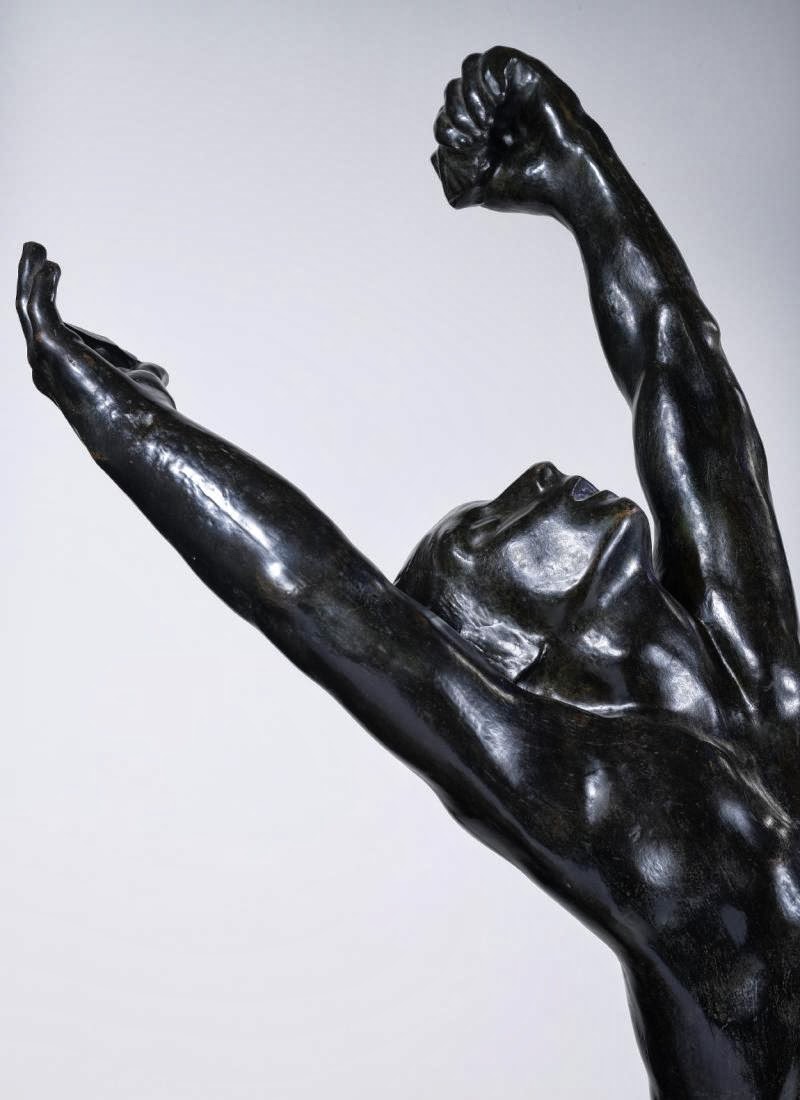
Here we see the artist's envisioning of the Prodigal Son.  Not to mention the figure's passionate gestures and upward-stretching body, the way light and shadow play over the uneven surface of the figure gives it life and vitality.  This sculpture is rich in energy, movement, and emotion.  Rodin intended to express joy and sorrow and pain.  The prodigal son, with head and arms reaching upward, is a powerful image.  His wealth and self-esteem gone, at the edge of despair, he pleads for forgiveness.  Here the artist's vision of pain and desperation is so effective that, like the father to whom the son pleads, you, the viewer, are moved to show forgiveness.
This is not a contemporary subject, so it feels out of place with the other Modernist works we have been looking at so far.  Rodin's Impressionistic style characterized his sculpting technique and the way in which he wanted to portray his figures, but it did not spread into his subject matter.  Although he did sculpt relatively contemporary images, such as his homage piece dedicated to Balzac, finished approximately forty years after the famous French writer's death, most of Rodin's works deal in past, Classical, or philosophical subjects.