Showing posts with label Post-Impressionism. Show all posts

Friday, June 20, 2014

Post-Impressionism (pt. 18)

Vincent left Saint-Rémy and was perceived to be improving.  He was, nonetheless, kept under surveillance by Dr. Gachet as well as his brother, Theo, whom the artist moved to live nearer to.  Out of the institution, Van Gogh painted outdoor scenes in his final days.  These scenes feature dark, foreboding skies and autumn imagery of wheat fields growing ripe for the approaching harvest.  Once again, these images are painted wildly with thick paints and violent dabs or brushstrokes.  The artist almost attacked the canvas with paint and sculpted his colors into their place with his bare hands.  His raging passions are clearly seen in the most expressive manner.  Yet these paintings almost harbor a transcendence of their own, like the earlier landscapes with the cypress trees.  There is something eerie but tranquil about these works.
In late July, 1890, Van Gogh walked out alone into a wheat field very much like the one painted here (in fact, it has been traditionally held that the artist went out to the very same field) with his easel and paints, assumedly to construct another work of art en plein air.  Instead, the artist shot himself with a pistol and returned, after spending who knows how long out alone in the field, to his lodging, where he was attended by physicians who arrived as quickly as they could onto the scene.  Several hours later, he died and was buried the following day, July 30th.  This painting is held to be the last of the artist's works.

Wednesday, June 18, 2014

Post-Impressionism (pt. 17)

In the last weeks of his stay at the hospital in Saint-Rémy, Van Gogh changed doctors.  Dr. Paul Gachet took charge of his care, and the artist chose him to be the subject matter of his next painting.  The Portrait of Dr. Gachet is still today one of the highest selling artworks in history, having been bought by a private collector in 1990 for just over $80 million.
Typical to Van Gogh's style, we see a lot of energetic brushwork here, conveying liveliness, intensity, and passion.  The world around this doctor is busy, with fluttering lines of light and color buzzing all around him.  (No clear background is distinguishable behind the sitter).  The doctor's uniform is a part of the external chaos, with its own vibrant colorization and form.  He's leaning on a table with two books and a vase of flowers.  The books indicate the doctor's breadth of knowledge and training.  The flowers are a species which were often used as medicinal herbs for treating unstable heart conditions.  They are extremely poisonous to ingest alone.  As to the doctor himself, he slumps, leaning on the table and resting his cheek on his hand.  He looks as if he were in a thoughtful pose, but the man's face betrays more than just deep contemplation.  Deep emotion appears to be "infecting" this doctor, turning his face an almost sickly green color and causing his eyelids to languidly droop.  He is anxious, sad, uncertain, and wholly despondent.  Van Gogh famously identified the look of the man with his generation and the commonly pervading sentiments of doubt and despair in the early Modern Age.  The artist has literally put a face to the gloom and hopelessness of the post-Victorian generation; and it is the face of a doctor who works in an asylum treating others' illnesses when he has no one to treat his own.
Here the patient is diagnosing the doctor.  Do you see?  Vincent Van Gogh was the mentally unstable patient under this learned and experienced doctor, but he commented in a letter to his brother in July, 1890, that he thought Dr. Gachet "sicker than I am."  And the artist has once again infused his own feelings and artistic style into the work; this poor doctor is crudely fashioned into a wobbling form, thin and crooked, as pitiable as one of his suffering patients to whom he so loyally attends.  Van Gogh paints him the way he feels the man really is, kind of like his own diagnosis of his doctor.  And it's quite a sad revelation; apparently both doctors and patients alike are unhappy.  The melancholy of Modernity infects all: doctor and patient, sane man and sick, student and teacher, artist and layman.  Although painted roughly enough, the themes of such a painting penetrate deep to the intricate recesses of the heart and mind.  The face of Dr. Gachet in the portrait conveys so much symbolic meaning which extends toward not just Van Gogh's own generation, but all of Modern society, all of humanity; and that this alleged healer of men's diseases should be himself more diseased than the worst of them is a statement on the human condition.  It's a profound work of art.

Tuesday, June 17, 2014

Post-Impressionism (pt. 16)

Art, now removed from a general audience and deviating from subject matter and realism, comes to be about the artist.  Stuck in a mental institution, Van Gogh is unable to be a flâneur among the crowd or a "painter of Modern life," as Baudelaire had defined for the previous generation.  Within himself, nevertheless, there is enough subject matter for a body of work that can last a lifetime.  If Monet established the complexity of particles of light and the simple subjects of haystacks and water lilies, then Van Gogh takes an even further step back to look into the complexities of himself.  Art, after all, is infinite; the possibilities are endless, since artists are not recreating reality.  The artist can paint any way he wants to; and Van Gogh chooses to paint the way he feels.
In this emotional work, of an Old Man in Sorrow on the Threshold of Eternity, the artist goes to absolute extremes to express himself through art.  The color scheme of the entire background and surroundings follow a consistent theme of browns, beiges, and oranges, but stuck in the middle of it all is a man whose color so starkly and intentionally clashes with the rest of the painting, that the painting appears to be in conflict with itself.  The deep blue of his clothes is so raw and vivid; Van Gogh wants to stress the image of this old man amid the cloud of his surroundings.  He sits alone in a chair and buries his head passionately in his palms, clearly overcome by some sudden pang of emotion.  Once again, the artist has saturated the canvas with paint so thickly that it sticks out from the painting almost in architectural relief form.  The amount of paint is over the top; the colors are intense; the subject is dramatic—this painting conveys nothing if not strong emotion.  We see an old man bent in agony and are given no context as to his situation.  Fear, regret, despair—whatever it is, his eyes are hid from us, and the only feature of his face that gets presented clearly is his bald head, emblematic of his old age and impending death.  This was a theme that Van Gogh doubtlessly felt personally.  He painted it less than three months before his own death by suicide.

Monday, June 16, 2014

Post-Impressionism (pt. 15)

While staying in the asylum at Saint-Rémy, Vincent's mental and emotional health did not show signs of improvement; if anything, his condition seemed to deteriorate.  Lonely, neurotic, and unhappy to an almost debilitating degree, the artist turned to painting as a means of coping with daily hospital life and avoiding total despair, mental breakdown, and insanity.  Art took on a therapeutic form—doubtless not for the first time in the history of the medium.  The psychological motivations behind the other painters we have looked at is left open for elaboration and investigation, but Van Gogh was one of the first to paint solely out of psychosomatic incentives: to release some of his emotions, his tension, anger, depression, and whatever else.  We are no longer looking at artworks made to be submitted to a salon exhibition or commissioned by a patron or other buyer; this art is a wholly intimate creation of the artist for the artist.  How, then, should we look at a painting like Van Gogh's Irises?
The influence from Japanese woodblock prints can be clearly seen here in the painter's use of color and shape.  A kind of pseudo-Impressionistic levity is employed in the artist's approach to realism and design.  We are given a nondescript, everyday view of something commonplace: flowers.  Nevertheless, any attempt at stylistic categorization is quite futile; this painting is violently rebellious against seemingly all other artistic approaches except Van Gogh's own.  This work is sheer chaos.  I hardly even know how to describe it; you can see for yourself.  We are looking at a tangled mess of cluttered stalks, shoots, leaves, and buds in anarchical placement within the frame.  Our eye is given no single linear pointer to direct us where to look; and inasmuch as there is no centerpiece to this painting, there is also no clearly distinguished background or foreground.  We have almost no idea which plants appear in front or behind others; they are lost in the dizzying forest of content patched randomly throughout the canvas.  We may take one look at this and immediately see the evidence of a troubled mind; and if we can understand nothing else from what we see here, we can most certainly spy the expressed marks of the artist's own neurosis.  As works of personal self-expression, paintings such as this of course betray insight into Van Gogh's mind, but they also extend the boundaries of what art can achieve.  The multifaceted development of art throughout Western history has been one of innovation and discovery, as we've come through seeing art as historical documentation, religious sermonizing, ideological propaganda, philosophical reflection, and even scientific study of the natural world (to name only a few)—and now, it seems, we can add medical/psychological treatment to the list.  That is certainly the function of this painting here.  Only someone as obsessive and neurotic as Van Gogh could have painted such an intricate maze of interwoven lines and shapes.  Our eye can't follow it, but it certainly speaks to our emotions the way it no doubt expressed some of the artist's own.

Sunday, June 15, 2014

Post-Impressionism (pt. 14)

Starry Night, probably the artist's most famous painting, carries reminiscences of the earlier work of the Wheat Field and Cypress.  Cypress trees stand in the nearest foreground and shoot up with wavy energy into the night sky above, drawing our eye there.  The sleepy town below is painted just so: sleepy, hazy, unclear in daubed, wandering brushstrokes.  Colors blend, and buildings mesh together with trees and bushes.  Amidst it all, a church is the only clearly delineated object that stands tall, like the cypresses to the left.  Both point our eyes upward to the night sky, as if to encompass the entities of nature and the establishments of humanity into common unity under the showy brilliance of the otherworldly expanse of the heavens.  But the subject is, quite simply, a starlit night.  This subject occupies a greater two-thirds' space on the canvas and is infused, through the artist's unique brushwork and stylistic technique, with the most light and energy of the entire painting.  The stars do not just glow; they radiate.  Each is pictured as a small orb with its own surrounding halo of light, a visible emanation of the star's brilliance in the eyes of the viewer.  In some cases, given their added radius of light, the image of a star even dwarfs the buildings in the town by comparison in size.  The moon is enormous.  Clouds or mist pass along in wavy energy, like the billowy clouds in the artist's earlier landscape painting of the Wheat Field and Cypress; but here, too, the sky itself is imbued with an aspect of organic restlessness.  With short bursts of paint, the artist has created a kind of stream (or gushing river) of linear motion which, the more we look at it, appears to have no direct or succinct path of movement.  (This leads us to conclude the artist is not painting wind, or else you'd expect everything to move in one direction).  Chaotically overflowing with color and vivacity, the sky itself is given new qualities by the artist.  It's practically a living thing.
The beauty of a starry night sky inspires one's imagination and emotions, and these are the qualities we see in Vincent Van Gogh's Starry Night.  One of the ideas most commonly associated with this painting is its liberation of the artist's potential for creativity.  Free to imagine the world in any fashion he chooses, Van Gogh approaches subject matter not just stylistically or expressively but wholly personally.  This is his view of the night sky, his interpretation, his reaction.  He has not painted a realistic vision of what the scene would actually look like in real life; he's painted his emotional response, his metaphysical connection and interaction with the subject matter.  The sky is alive; the stars are great, big, luminous bodies, and the air is full of color and vibrancy.  A normal night sky would be much more static and restrained, but that is too tame for Van Gogh.  He has instead taken from outside, tangible (or, at least, visible) subject matter and added his own creative vision of the scene.  Like Goya, he's painting from imagination; but also, he is painting from feeling.  Unsatisfied with the undemonstrative simplicity of a normal night sky, he can use the medium of art to create a more vibrant landscape that better relates to one's appreciation of it: full of overwhelming emotion.  Art, after all, allows for the capability of artistically adding to nature, anthropomorphizing the abstract, and inventing a world entirely one's own.  Actually, in art, just about anything is possible; and this is the creative freedom Van Gogh assumes and exudes here.

Thursday, June 12, 2014

Post-Impressionism (pt. 13)

Vincent Van Gogh was a troubled man.  He suffered from severe bouts of depression and loneliness.  A smoker and a drinker of absinthe, he is also believed to have suffered from the hallucinogenic effects of turpentine, a chemical found in many oil paints which, if ingested, can cause serious side effects.  Artists of the time who would commonly rest the tip of their paintbrushes in their mouths for meditation while painting could run the risk of acquiring turpentine poisoning.  Although much debate surrounds the cause of Van Gogh's mental illness, we do know that he was in fact ill—and Van Gogh knew it, too.  Shortly after cutting off his own ear (which he then wrapped in newspaper and handed to a prostitute at a nearby brothel), he was admitted to a hospital, where his condition continued to deteriorate.  When he was finally released, Van Gogh, knowing he was not well, checked himself into an asylum in Saint-Rémy, where he would spend the next year of his life.
From this asylum, Van Gogh painted some of his most memorable paintings.  Perhaps their celebrity comes partially from the significance of the artist having painted them while a patient in a mental hospital; with that context no doubt emerge special meanings and added, psychological interest.  The study almost becomes subjective when trying to appreciate such artwork, but for their sheer artistic value we will take a look.

Wednesday, June 11, 2014

Post-Impressionism (pt. 12)

Similarly, this painting of The Café Terrace at Night is expressive of the artist's ability to magically bring us into an environment.  This painting exhibits beautiful colors that exquisitely convey the aspects of this scene.  The warm, golden light of the café, inviting and homely, glistens and glimmers near the center of the work, with a light shining near the center and an awning hanging overhead.  A red carpet is laid out underneath all the tables and chairs, inviting people to come and sit.  The red is warm to match the yellow of the café; it establishes the place as a location of activity and socializing.  We can see people sitting in the distance in groups.  On the right half of the painting, the scene opens out into the night, blue and black, receding far into the background.  Small, dim lights glow from windows in the distance as stars shine in the sky above.  Everything else is dark and shadowed in the night, which would look foreboding if the warm café wasn't in the foreground making us feel comfortable and safe.  The stars are painted far too large, disproportionately large, but Van Gogh felt they were significant to the scene and therefore sought to exaggerate their presence.  After all, few sights can compare in beauty to a clear, starlit night sky.  The splendor and tranquility of such a scene is enchanting, and Van Gogh paints from a perspective of someone just about to walk into the door of the café, as if his painting's invitation is too good to refuse.  It's at night, and yet it's so colorful, so vibrant, and so expressive, that it almost makes no difference.  The imaginative quality in this work no doubt speaks for itself.  It is a picturesque scene, majestic and beautiful.

Tuesday, June 10, 2014

Post-Impressionism (pt. 11)

In this painting of a Wheat Field and Cypress, painted in 1889, we can also distinguish the artist's creative skill for depicting the energy and liveliness of the landscape.  Not similar to the static and still landscape works of Claude Monet, this painting shows wispy, twirling clouds gliding along in the sky and stalks of wheat and grass blowing in the wind.  The curvy lines of the trees and bushes lend vibrancy and energy to the scene.  Once again, rich colors, thickly applied, populate the canvas, and the artist's brushstrokes are clearly visible.  He is in the landscape, painting en plein air, and he is bringing us into the landscape with him through the elements of wind, air, and light.  In that sense, the painting is quite effectively expressive of itself, relating its own qualities to the viewer in a way that brings us on equal footing with the subject.  It's subtly transcendent in a way that (I think) communicates through abstracts and emotions.  We can look at it and almost feel the environment, picture ourselves in such a place, and be taken away from our current surroundings.  And it is once again a lonely scene and perhaps even in a way mournful.

Monday, June 9, 2014

Post-Impressionism (pt. 10)

The artist painted thick, gestural brushstrokes with layered globs of paint onto his canvases to create a sense of energy and movement.  He wanted to create and inspire feeling, emotion, even passion into his artwork.  This gave his approach to form a completely new look, but it also inspired his bizarre methods of painting.  In this Still Life of a Vase with Twelve Sunflowers we can clearly see the artist's brushwork.  Click on the image and enlarge it to see what I mean.
Van Gogh sometimes squeezed paint straight out of the tube onto his canvas and used his fingers to brush it one way or another.  Some of the thick globs of paint on his works are still wet today, there is simply so much paint there.  Talk about an overflow of emotion—the artist has almost poured out himself, in paint, onto the canvas.  Flowers are a delicate subject matter, but here we see an excess of paint and flood of bright, neon colors.  Granted, sunflowers are larger and bulkier plants than tulips, but Van Gogh's thick paint goes a level too far.  And observe his signature, one of the largest in the history of art: "Vincent" across the front of the vase in bold, noticeable letters—not his last name, which would be more professional, but his first name, more familiar, more honest, more open.  He is putting himself down into his painting.
This allows for an unprecedented level of stylistic uniqueness that distinguishes this artist from all the rest.  When we look at a Van Gogh painting, we are very aware that we are looking at a painting by Van Gogh.  This is the way in which he paints.  His art is, in a sense, a conversation with himself; and we as viewers are allowed in on the intimate discussion of color, shape, and design.  In truth, the artist's works were very personal to him.  Since Van Gogh wrote so many letters and documented his life in writing so thoroughly, we (on a surface level, at least) basically know everything about his life; and this allows us to enter into the world of his artwork.  This otherwise personal area of his private life is revealed to us as the ultimate form of Post-Impressionist method: the Impressionism of oneself.  This was a matter of self-expression for the artist, not about outside subject matter or the patronage of any viewership within the public sphere.  In his entire life, Van Gogh only ever sold one painting, and that was to his brother, Theo.

Sunday, June 8, 2014

Post-Impressionism (pt. 9)

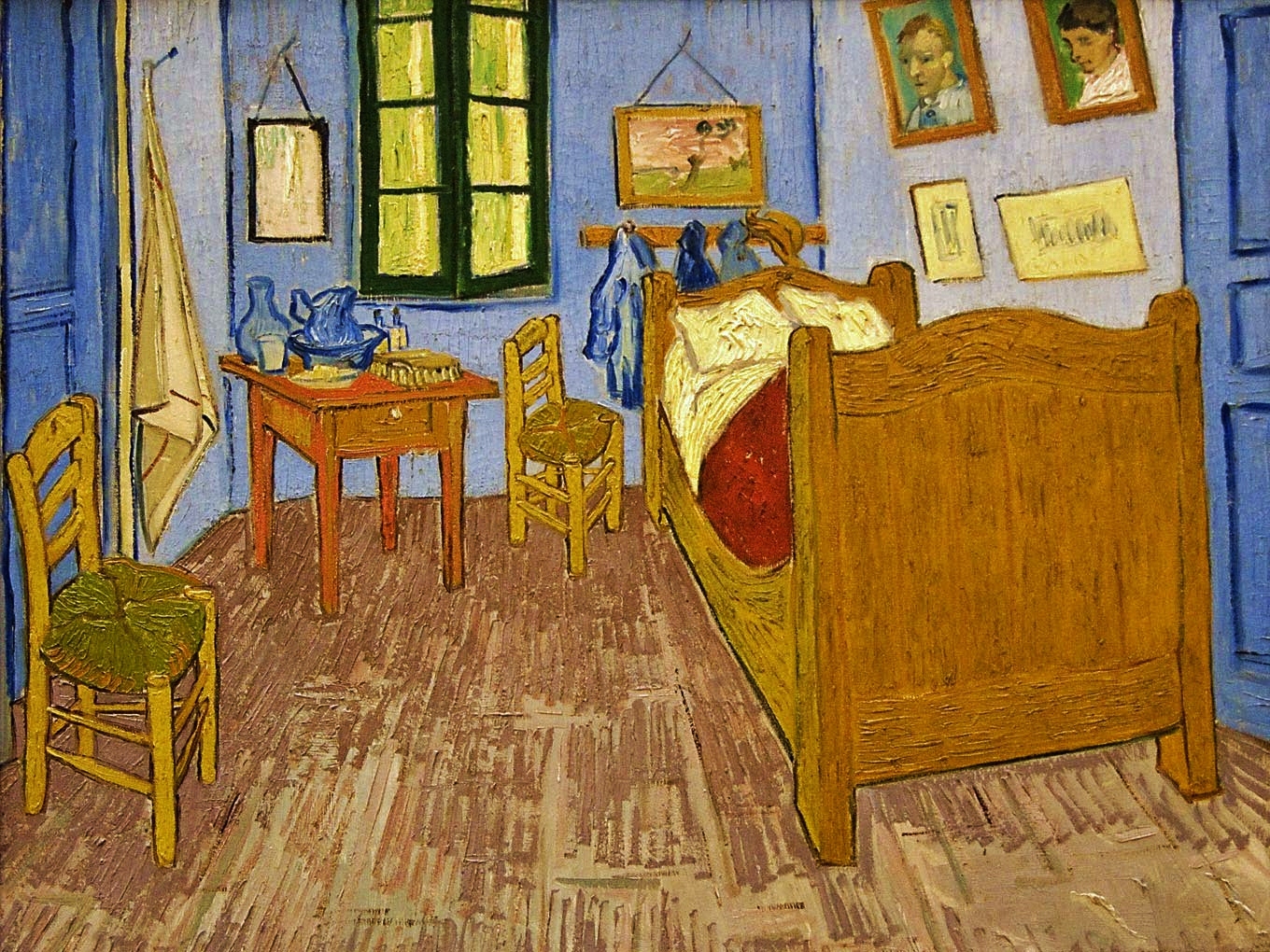
The artist painted this scene of his Bedroom in Arles shortly after finishing The Night Café, and here we feel equally drawn into a cozy environment while once again feeling incredibly alone.  Here there are no people.  There are two doors, two windowpanes, two chairs, two portraits, two drawings, and two pillows—but only one person.  Van Gogh never married, but instead lived alone.  Here we can no doubt feel some of his loneliness.  Nearly all objects are painted in pairs, but the bed, like an enormous tombstone, stands awkwardly alone.  Through this painting we are not granted any profound insight into subject matter: since the subject is merely a still life-type look at the artist's bedroom (nothing significant about that).  It is instead an insight into the artist's own mind, his feelings and thoughts, more than it is a statement about any external subject.  The painting is of the bedroom, but the theme rests in the room's sole inhabitant.  They say a lot can be told about a person based on looking at the room in which he or she lives.  In the same way, Van Gogh has poured a lot of himself into the painting he has created.  This is self-expression through art, not analysis or coverage of an outside topic, like, say, sunlight or the king of France.  This painting is created within the confines of the painter's own knowledge of himself; but instead of a self-portrait we see his bedroom.  He has translated qualities of himself to an external subject, but it is still primarily about an expression of himself.
This type of approach to art would earn Vincent Van Gogh the label of Expressionist painter.  As Impressionism took from Realism in the sense that it sought to paint the physical world as it really appeared (or as it was impressed upon someone at a given moment of time), Expressionism did not take inspiration from the material world.  This kind of art functioned solely to convey the emotional feelings and reactions to various subjects.  Like Symbolism, this style focused on abstracts.  Van Gogh painted what he felt, not what he saw.  If the leading Impressionist painter, Claude Monet, painted exclusively as an eye; then this artist painted solely as a heart.  This could inspire how he painted objects, as well.

Saturday, June 7, 2014

Post-Impressionism (pt. 8)

Among other artists, Van Gogh fervently studied the Japanese woodblock printers and mimicked much of their work.  The colorful design of Hokusai's prints greatly influenced him, and he produced several works directly copying the style.  This would have identified him with the Impressionist movement, but as Van Gogh continued to develop his painting approach he took to new methods of painting that would completely distinguish him from the rest.
After a couple years in Paris, the artist moved to Arles in the South of France.  There his paintings grew even more unique.  This painting shows a popular café in the area which the artist visited, and it is shown here at night.
In this Night Café, we see only a few scattered patrons hunched over their tables in silent thoughtfulness or drunkenness.  A waiter dressed in white stands by a billiard table and looks at the viewer.  The clock on the wall tells us that it is fifteen minutes past midnight, and the crowds have gone.  If Van Gogh the Impressionist is trying to be a flâneur and observe the social night life here, then he is doing a pretty bad job of it.  Everyone has left; there are only a few people remaining.  Just what is the artist trying to accomplish here?
For starters, we notice the deep red of the café walls and the rich green of the ceiling.  The two colors clash and cause the room to appear more stark and vivid.  The lamps overhead also seem to add to this bluntness; Van Gogh has actually painted the light coming from them.  For all of Claude Monet's efforts to capture sunlight and its effects on an environment, here Van Gogh has simply brushed tiny, circular streaks around the lamps to, in effect, literally paint light.  There is no need to walk around it; he paints it stark and bare, vividly visible.  And we can see the boards of wood along the floor in the streaks of brushstrokes the artist has painted.  The perspective even seems to focus on this aspect of the scene; a good two-thirds of the canvas is devoted to the floor, as if the viewer had his head drooping down.  The painting has no center.  The closest to a central object would be the pool table, but this is off to the side for one thing and, what's more, is painted crookedly with awkwardly shaped legs.  It looks like it could fall forward, out of the painting.  In the closest foreground are two empty chairs, faced in opposite directions.  Their contrast matches the red and green of the top portion of the painting.  The café harbors latent philosophical contradiction.  The reds and yellows are warm and inviting, but the greens are lurid and foreign.  With its abundance of bottles and absence of people, its billiard table with no players, and its inviting warmth but downward-facing viewer, this café is a working contradiction within itself.  And the artist doesn't need to paint it full of people to capture the spirit of the environment itself.  We are brought into it all the same, but we are brought in quite alone.  The waiter's distant stare at us from across the room further isolates us, as do the placement of the few other people in the room, who all sit far away.  We are alone, looking into this room; and although the warm feel of the place and the generous supply of drinks help to invite us in, we look mainly toward the floor and hang in the back.  The contradiction of the café turns into the contradiction of the painting itself—and of the painter.

Monday, June 2, 2014

Post-Impressionism (pt. 7)

Throughout his life, like Rembrandt, Van Gogh painted and re-painted himself in different lights and with different approaches.  His self-portraits have been the fodder for intense and highly debated psychoanalysis, and doubtless for a man like Vincent Van Gogh this approach to studying his art can lead to very interesting, if not enlightening, conclusions; but I will endeavor to stick to the artistic side of his work, since my chief interest is in conveying the importance of his art's impact on our study of Western art history, and forget Freudian psychology (for now).
After his move to France, Van Gogh's paintings became almost immediately infused with color.  Vibrant, vivid, and even excessive, the colors in these later paintings of his surge with a kind of kinetic energy along the surface of the canvas.  We'll see this more in just a little bit, but for now we can see an immediate change from the previous approach to painting which we saw with The Potato Eaters.  Here the artist has painted himself with dots and quick, tiny brushstrokes of color that range all across the spectrum of the color wheel.  On his face alone we see beige, red, orange, green, brown, and blue—all quite extreme colors and not toned down or mixed to a lighter shade.  They are merely dabbed in scarcity here and there to add a vibrancy and electricity to the image.  We barely notice that we are looking at so many colors, but our eye nonetheless feels the attraction to look at this image.  On his coat we see even more colors: purples, turquoises, pinks, and reds.  White lines his collar, and a bright blue patch marks a necktie or cravat.  As if that wasn't enough, the background of this painting is sheer color.  The viewer is given no sense of location or environment.  All Van Gogh has done is paint dabs of color all around him, as if lost within his own painter's palate.  And the colors aren't even subtle, either.  Blue clashes with red clashes with green clashes with orange clashes with violet—what on earth is going on here?  All these dots of color spotted onto the canvas and surrounding the painter appears chaotic, overpowering, eclectic at best.  Why so many colors?  The answer to this simple but greatly significant question is made clearer as we delve a bit deeper into Van Gogh's artwork….

Friday, May 30, 2014

Post-Impressionism (pt. 6)

And here is where we arrive at Vincent Van Gogh.  A Dutch Impressionist painter who later moved to France, Van Gogh did not begin his career as an immediately distinguishable painter.  His early work mimics the traditional techniques of Realist artistic style, and this we can see in paintings like The Potato Eaters.
Though definitely stylized and uniquely drawn, the painting nevertheless borrows from established conventions of art theory which were still popular at that time.  The subject matter is of peasants (very Realist), and they are painted under dim light, similar to Millet's painting of The Angelus.  They are, however, characterized by a new, unrealistic look.  Van Gogh has almost drawn caricatures instead of real people.  The poor crowd around the table appear shabbily drawn, humbly undefined, and simple.  Through this technique the artist gives a statement about the Dutch lower class and how such a people were viewed by society.  This approach to subject matter is typical of Impressionism, as we have seen (such as in the works of Toulouse-Lautrec).  And the light overhead connotes God's presence with these humble folk, again very much taking from traditions of Realism and Millet.  Yet there is a boldness to the brush, isn't there?  Paint is almost scratched onto the canvas here.  The scene is painted quickly, according to Impressionist practice, but instead of a light, airy snapshot of some ephemeral moment, this scene feels heavy.  The dark colors are dense and vivid.  If Impressionism was about the study of light, then already Van Gogh here is demonstrating a level of rebellion in his own art style.
This was the early work of the artist.  His paintings are rich in color, but nowhere near the excessive overabundance which would appear in his later work.  One or two hues would suffice for his artwork, and they were always dark.  This is how he decided to paint the peasants of his Dutch home, with moody and dark overtones and a humble suppression of photorealism or image clarity in order to effect caricatures or impressions of his subject matter.  This is Impressionism, but rather dark Impressionism (if there is such a thing).  It was the artist's move to Paris that inspired his style to explode into a completely new form of art that would forever change the dynamics of art history.

Wednesday, May 28, 2014

Post-Impressionism (pt. 5)

Taking plein air painting to new extremes, Gauguin sought exotic locations in which to paint, looking for the perfect "paradise" to depict in his artwork.  This infused his art with vibrant colors far from the soft pastels of the Impressionists.  Everything seemed brighter and more strikingly vivid in the South Seas, Martinique, and Tahiti: crimson rocks, gold trees, and violet hills—so different from the industrial mire of London and the other Modern cities which had defected from their pastoral purity and been turned into colorless, characterless metropolises.  But hints of the old Romantic atmosphere could be found in the exotic locations of French Polynesia (among other places).
Met in these places by not just color and atmosphere, Gauguin found operating within this new hemisphere an entirely new culture and an apparent simplicity of life (noble savage).  When the artist went to Tahiti, it changed his style and his art.  He instantly took to painting the natives and depicting them in their environment and their culture.  Since everything in their exotic location was so full of color, and since he found their culture so rich in Romantic purity, the artist painted his Tahiti scenes with utterly vivid colors—some of the most vivid ever to enter into the history of Western art.  His canvases are resplendent with color, but even this was not enough.  The enchanting experience of living within this quixotic environment became Gauguin's subject matter, in all of its magnificence and profundity.  His paintings became about the wonder of exotic Tahiti and the poignancy of life among the native peoples.  He would start with subject matter (such as portraits of the natives) and then "shut his eyes in order to see."  This visionary approach resulted in such famous products as this painting of a scene By the Sea (Fatata te Miti, as it is titled), from 1892.
In this work of art, the painter is not concerned with creating a real sense of space but focuses on flat, colorful shapes and contour lines.  Gauguin simplified the shapes he observed as part of his technique to convey the uncomplicated purity of this society.  We can hardly tell where we are in this painting, only gleaning impressions of flowers, plants, and wavy water lines.  The rich colors depict Gauguin's image of an earthly paradise, utterly unique from anything our minds could have imagined.  And yet within this wondrous world are still some familiar elements of brooding uncertainty.  The horizon line atop the far right-hand corner of the work fades into the distance, undefined, and gradually growing darker.  The farthest figure out in the water is a hunter with a spear, carrying with him the notions of killing and mortality.  The woman diving into the water toward the middle of the work seems to be more falling forward than purposely diving in.  She stumbles ahead into the future and will eventually fall into the water to be buried under its surface (again, symbolic of death).  Even within such a wonderland, Paul Gauguin found some ancient and grim truths sneaking onto the scene like a snake in the grass, and these more philosophical concepts fueled much of his later Symbolist artwork.

Tuesday, May 27, 2014

Post-Impressionism (pt. 4)

Paul Gauguin exhibited as an Impressionist before moving on to his own style.  Unsatisfied with Impressionism as it currently stood, he began work on developing new ideas inspired by the Japanese woodblock prints which had been so inspiring to his contemporaries, finding within them not merely a lack of spatial construct but a cultural tone of symbolic significance.  He saw that the way in which something was painted communicated ideas about that thing, and that through art painters possessed greater liberties in communicating with an audience because they could not only paint selected scenes and items but could paint them stylistically.  In effort to push Impressionism forward, then, Gauguin joined the artistic school of the Symbolists.  Symbolism was, essentially, the artistic theory that art could, given its unique medium for creative expression, and should, given artists' higher calling to record truth around them, concern itself chiefly with the representation of intangible truths and ideas that could be expressed in no other ways.  To put it in terms of an example, no other medium could, theoretically, put an image to the abstract quintessence of, say, love or sorrow.  A painting could, in effect, record such a thing.  These artworks could be symbols of the immaterial aspects of everyday life in the way that Impressionism was about recording visually the scenes of everyday life among the multitude.  These paintings, therefore, frequently show angels or representative beings like Death, Wisdom, et cetera (just what Courbet promised he would never paint).
With these motivations, then, Paul Gauguin painted The Yellow Christ, a totally new look at an old topic: the Crucifixion.  We can see immediately that the artist has painted this scene in a wholly untraditional light.  It has been stripped of its realism and painted with the simplicity of cartoon imagery.  What's more, the scene itself appears toned down, and the thematic material, softened up.  Never has the Crucifixion looked so pacified and tame.  There is no blood in the painting, and Christ's crown of thorns is noticeably missing.  The expression on Jesus' face seems to be one of calm relaxation, not excruciating agony.  Golgotha, the place of our Lord's death, has here been changed to a peaceful, pastoral setting, filled with rich, red autumn trees (which, by the way, form hearts).  And replacing the mocking crowd of jeering spectators is a group of humble nuns who quietly accept the scene with some passivity.  Some people are offended by this painting.  It almost looks sacrilegious.  Just what is the artist doing here?
As a Symbolist, Gauguin painted the qualities of ideology attached to a subject matter within a painting of that subject.  When considering the sufferings of Christ on the cross he thought of the widely instituted religious connotations that such a scene had come to signify in his contemporary culture; that Christ's Passion was an expression of His love, and that His death was a gift bringing peace and redemption to those who would put their faith in Him—(haven't researched Gauguin's personal religious beliefs, so don't misinterpret me; this is a staple of broader Christendom at that time, not necessarily his own convictions).  Therefore, the death of Christ represents something sweet to the Believer, something in which he can take comfort and look to with fondness—(and, by the way, these ideas are not expressive of my own beliefs either, let it be clearly noted).  Through Symbolist style, then, the artist sought to re-imagine the Crucifixion in the way people tended to think of it, or respond to it: with sentimentalism.  That is why it does not appear realistic.  The intensity of the colors (their brightness and purity) is exaggerated because the event has so starkly continued on into the Modern world in its telling and retelling, losing (allegedly) its accuracy over the years and entering into the category of traditional folklore or childlike faith, rather than splendorous revelation of profound truth, like the Renaissance artists portrayed it as.  Everything is moderated here.  Do you remember Grunewald's depiction of the Crucifixion?  Compare that to this, and the difference goes beyond black-and-white extremes.  Religion, however, had grown to become the societal institution for moral order and peaceable courtesy.  In the Victorian Age, a "good Christian man" came to mean a well-behaved, genteel man of upstanding character and reputation; it was something respectable, temperate, and nice, so no wonder this Symbolist representation of the Christian faith is painted with such gentleness and pleasantness of form.  Christ's love, forgiveness of sin, reconciliation with God the Father are all positive things; so why paint a Crucifixion scene that's depressing, violent, and austere?  (These are some of the notions of the Symbolist art theory behind this painting).

Saturday, May 24, 2014

Post-Impressionism (pt. 3)

In pursuit of the best method for painting the object in its honest, physical bulk, Paul Cézanne turned to a technique that simplified surface areas of space into compartmentalized sections of color and brushwork.  Cézanne painted small cubes of color that distinguished different textural planes of an object's outward surface.  Through thickness of paint and changes in the direction of the brushstrokes, he could delineate the subtle alterations of an object's mass.  This may sound complex, but in fact the artist was trying to formulate a less complicated way to paint the three-dimensional by narrowing down the focus onto specific qualities of mass, volume, and external surface texture.  These ideas later became the foundational inspiration for Cubism; and there they are perhaps more readily explicable.  For now we can see examples of what Cézanne is doing in his Mont Saint-Victoire series.
This is just one of a series of paintings the artist made of a mountain in southern France.  Cézanne painted it 60 times.  With a closer look at the artist's brushwork, we can detect his method for blocks of color.  The mountain is painted in chunks, with altering directions of brushstrokes wherever the mountain surface has changed.  This is also true of the valley around it.  Trees, bushes, and flatland have all been compartmentalized into chunks of color and consistent paintbrush movement.  This breaks down (almost mathematically) the three-dimensionality of the scene and therefore better translates it to the flat canvas of the artist.  In theory, this was the problem which Cézanne was attempting to solve with his techniques, but it simultaneously lessened the realism of his works.  He was more concerned with conveying the ideas behind a certain aspect of the object than in painting realistically an entire scene.  This, too, was a form of Impressionism; but the Post-Impressionists took the physicality of Impressionism (its emphasis on the visual world, on sunlight and atmosphere) to new levels.

Wednesday, May 21, 2014

Post-Impressionism (pt. 2)

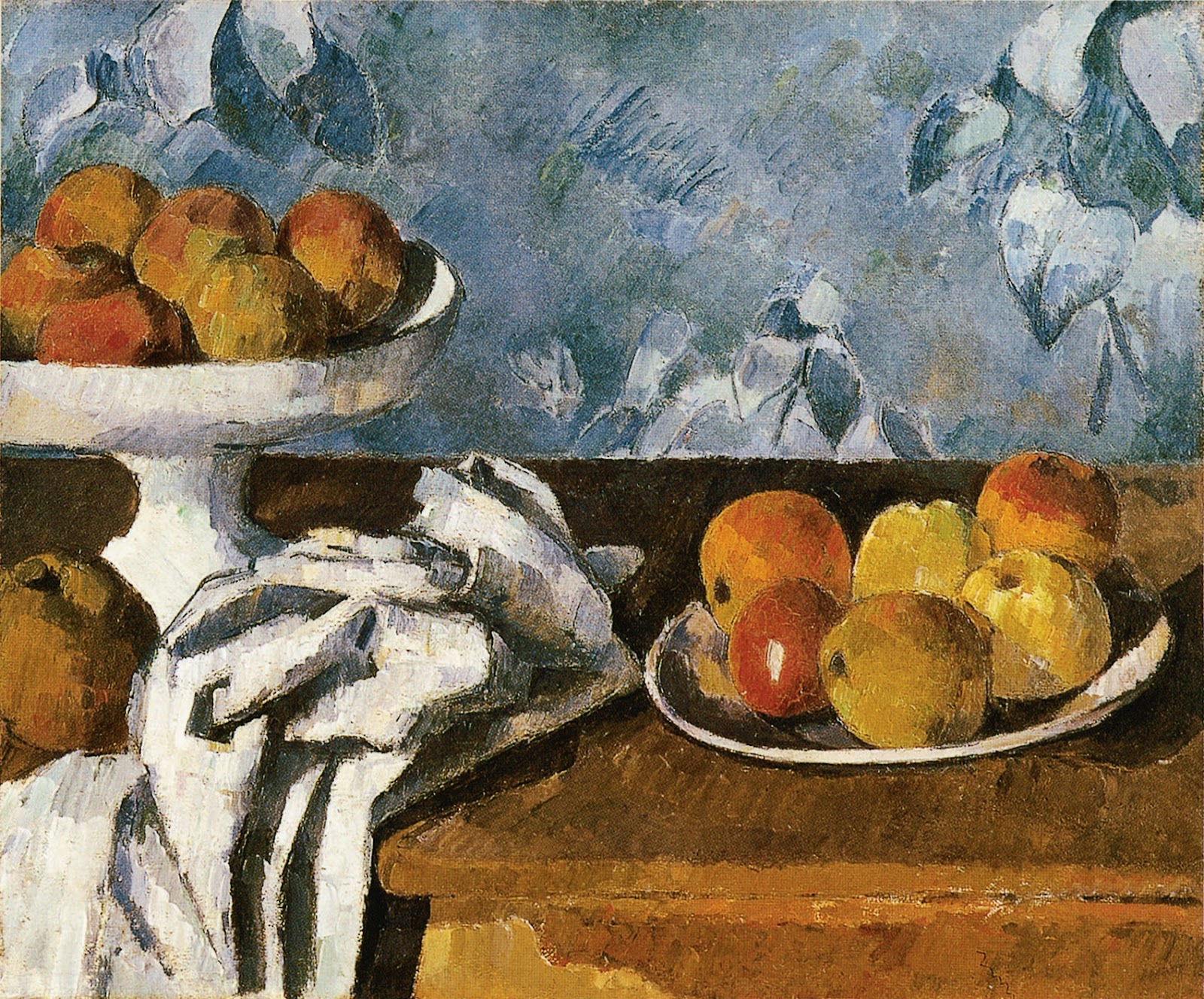
Through still lifes the artist was allowed to paint the same subjects over and over to perfect his work.  Cézanne did not even begin to seriously paint figures and landscapes until later on in his career.  His still life paintings were a way in which he could perfect his craft and develop his style.  Again, like the Impressionists, we see an emphasis here on the technique of painting, not necessarily the artistic inspiration of a particular subject matter or theme.  Artists in the Modern Era are redefining paintings, and this lends an objectivity to their work.  No great Classical scene is being shown here; no important person or significant biblical scene—not even an implied moral message—is being shown here.  Cézanne's Still Life is simply a study of fruits, bottles, and tablecloths.  The artist, nevertheless, famously said, "Je veux conquérir Paris avec une pomme" ("With an apple I will astonish Paris").  In this Still Life we see a peppermint bottle, glass carafe, and empty wine cup along with various fruits on the tablecloth of a mostly hidden table.  The cloth appears massive as it falls off the table and swirls around the objects.  The whites and blues of the wall, bottles, and tablecloth all generate a cool temperature of color within the painting, but Cézanne wants us to look at the fruit; these he has painted with vivid reds and yellows that instantly attract our eyes.  The artist has painted these so starkly in order to communicate their sense of mass and volume to the viewer.  The tablecloth, after all, is flat (or would actually be if it were lain out straight, instead of bunched up on the table), and so is the wall in the background.  These objects are therefore not as "full" as the fruit.  The glasses on the table are empty (through one we can even see another fruit behind it).  The only items in this still life which bear weight, either literal or figurative in this case, are the apples, peaches, tomatoes, and lemons, because they have mass and are fully three-dimensional objects of space and volume.  They are solid.  So the artist gives them rich colors to define their presence in the scene.  And don't they look stunning?

Monday, May 19, 2014

Post-Impressionism (pt. 1)

The French art movement that immediately followed Impressionism still regarded light and its effects on color; in addition, the most influential artists of this developing Post-Impressionist style, such as Paul Cézanne, Vincent Van Gogh, and Paul Gauguin, wanted more intense color and stronger forms.  This is the type of art we see during the late 1880s and 1890s in Paris—and Paris was the art center of the world.  In continuation of the artistic theories of Impressionism and then of the preceding generation, we begin this period with a look at the works of Paul Cézanne.
Cézanne believed that Impressionist paintings lacked form, solidity, and structure.  The wispiness of their brushstrokes did not definitively convey an object as the chosen center of focus, and the scenic layout of their works threw away a convention which Cézanne thought necessary to keep for art's sake: structured order and strategic placement of objects (like a still life).  His goal was to make "something solid, like the art of museums."  So he painted arranged objects, rather than painting them as he found them.  This approach was not too realistic, then, but Cézanne did not mind constructing a fake structure around the image so as to better depict the object.  He discarded anything that he felt was unnecessary.
In this still life painting, he has arranged four skulls in a pyramid-like fashion, not as they would naturally appear in the real world.  He has moved them onto a tabletop or some other surface (the artist doesn't delineate) and intentionally placed them in this construction, a fake layout, quite different from the candid images of Impressionist art.  The Impressionists sought to make observations about the natural world through art, so artists like Renoir and Monet painted scenes as their eye saw them, not always containing formatted structure or clarity.  Cézanne's art took greater liberties with rearrangement and alterations from the natural forms of objects in order to better narrow in on the painter's own objective, which, in Cézanne's case, was to focus on depicting the object itself.  The circumstances around the object and the object's own placement within an environment didn't matter—after all, this was art.
This is why his early still life paintings don't look realistic.  The artist was willing to sacrifice realism in order for certain objects to appear solid and heavy.  It was part of his devotion to the object; that it had to be depicted in as comprehensive a manner as possible for art.  And arguably the most daunting aspect of any object when contextualized in a painting is its mass and three-dimensionality.  So Cézanne would brush up his canvases with thick strokes of paint to convey the thickness of an object's volume.  Up close, this style appears flat, but when you stand back the items in these paintings take on a solid, semi-3D form.  This technique better delves into the nature of the object, as opposed to the effects of light or atmosphere on the object's appearance, and therefore (theoretically) gives a better impression of that object's true essence.