Showing posts with label Realism. Show all posts

Saturday, January 25, 2014

Realism (pt. 9)

Most scandalously he is regarded today as the first painter to create an explicit image of the female genitalia.  It was a private commission, not intended for exhibition at a salon—and it would have been instantly rejected anyway.  It's a small painting, very straightforward, and Courbet entitled it L'origine du monde (The Origin of the World).  By straightforward I mean that the image focuses solely on the subject from the chest down—there is no face to the female figure.  The body is lying on a bed of white sheets, and no other context for the setting is given.  Because of this, and because the woman has no face, this painting has been held in extreme controversy as a work not of art but of pornography.  Now, I don't really want to have the discussion of art vs. pornography right now because, frankly, it's going to hold us up from continuing on with the material (and that's what I'm interested in).  It's a discussion that perhaps must begin here and will be more fully realized later on as we continue to move through the timeline of art history, but it's a discussion that's still going on to this day.  And to avoid a brusque dismissal of this important debate, I don't want to simply quip about it now with my own opinion and then move on.  This is something we can go back to.  For now, however, I suppose there are one or two things that must be said immediately.
Courbet titled it L'origine du monde, indicating this as a statement or concept painting that invoked "the world" as its ideological or philosophical subject matter.  This enlarges the interpretations of the otherwise narrow-minded, explicit content of the image; there is latent meaning implied through its title, giving the painting additional, abstract qualities of subject matter in supplement to its visual elements.  Paintings have been conveying ideas for centuries; this is nothing new.  Michelangelo's Sistine Chapel fresco of The Creation of Adam conveyed ideas about the inadequacy of Renaissance humanism as a spiritual philosophy for its worldly focus on self ability.  Going back even further, medieval illustrations and sculptures used images to express ideas and tell stories about the life of Christ.  It is no exceptional thing, then, to argue that Courbet is here using an image to convey an intangible idea (or several ideas).  Perhaps most readily, a student of the artist's life work can distinguish a satirical approach to the Renaissance-era idealization of female nudes in mythological paintings of goddesses, such as Botticelli's Birth of Venus or Titian's Venus of Urbino, artwork in which nudity is validated merely by putting it in the context of mythology or spirituality.  Courbet, the Realist painter, no doubt wanted to show the female nude in a new light—the way it actually looks.  There is a truth-seeking sentiment behind that, someone who wants to paint the world for what it really is for the purpose of honest self-examination.  If people are all born from women, then, Courbet suggests, it is a valid subject to paint.  This is the world's "origin," a kind of mock-biblical Creation account of mankind's genesis; and, also like in Genesis, there is the element of temptation in the painting.  Eve as the temptress, the seducer of Adam, is perhaps the subject—or even the serpent, if you look at how Courbet paints the form of the subject's cylindrical body stretching down on the bed, almost snake-like, and if you consider the more animalistic side to not attaching a human face to this figure.  There are several potential interpretations of the form and structure to this complex painting, not just the obvious, smutty reading of it as cheap, base titillation.
Written into the sincerity of the work is the desire for human connection, intimacy of race, of self, and the nakedness of the soul.  The philosophy is that the nude is more identifiable, more quintessentially human, and more true; that it is the most honest image one can have of those often elusive and otherwise unfathomable bipeds, people.  This is not the same as the spiritual self-discovery practices of the nudists; artists like Courbet (at least in theory) intend to tap in to the broader relationship of all human beings, on a whole, transcendent of individual distinction and collective in common bond to the concept of the Oversoul, hoping to thereby attain some higher truth about mankind.  On the subject C. S. Lewis begs to contradict and writes:

Are we not our true selves when naked?  In a sense, no.  The word naked was originally a past participle; the naked man was the man who had undergone a process of naking, that is, stripping or peeling (you used the verb of nuts and fruit).  Time out of mind the naked man has seemed to our ancestors not the natural but the abnormal man; not the man who has abstained from dressing but the man who has been for some reason undressed.  And it is a simple fact—anyone can observe it at a men's bathing place—that nudity emphasises common humanity and soft-pedals what is individual.  In that way we are "more ourselves" when clothed.  By nudity the lovers cease to be solely John and Mary; the universal He and She are emphasised.  You could almost say they put on nakedness as a ceremonial robe—or as the costume for a charade.  For we must still be aware…of being serious in the wrong way. (The Four Loves. New York: Harcourt Brace Jovanovich, 1991. Print., p.104)

Although the context of Lewis's statements deal with real-world observation, not artistic expression, they nonetheless provide valid points crucial to the understanding of this abstract concept of Nudity as an artistic or real-world motif.
This painting was so scandalous that it was not put on public display until 1988, 122 years after its creation.  It was only officially bought by the Musée d'Orsay some twenty years ago, but it attracted a lot of attention most recently in early 2013, when an art collector proposed he had found, in a separate canvas of just a female head, the "missing piece" of the original painting.  The tv specials produced about the find were almost completely censored from showing Courbet's painting.  (As highly controversial as his art was then, there are paintings by Courbet which are still to this day censored by the FCC from appearing on broadcast television).
I don't want to make the distinction.  It is for you to decide what your opinion is on artworks such as this, whether they are truly "art" or simply pornography that has been promoted to look like art with a lot of high-academic pseudo-intellectual babble.  However, in order to offer educated and really well-founded thoughts to the discussion, it is critical to know what we are talking about when we label something as art and something as pornography, lest we find ourselves making hasty and ignorant judgments about something we know nothing about and have no business talking about.  Part of the reason we are examining such a broad and comprehensive timeline of art history is for the goal of better understanding, so that we can better tell what art is.  With a more educated approach to art, we are all more likely to be well prepared and well equipped to face such heavily debated questions as the art vs. pornography problem going on right now—and not make hasty generalizations.  The study of art can lead to more rational, educational, and profitable discussion, which I would welcome.  …There, that is where we must stop now in order to continue on with the material.  Our discussion on this topic is not over—there is more to be said; this is just a piece—but there will be time for that later.  Not to silence any readers who would flag me here and now—I welcome questions and comments of course, as always—but for now I'll just march on until somebody stops me.  Next we move on to Modernism…

Thursday, January 23, 2014

Realism (pt. 8)

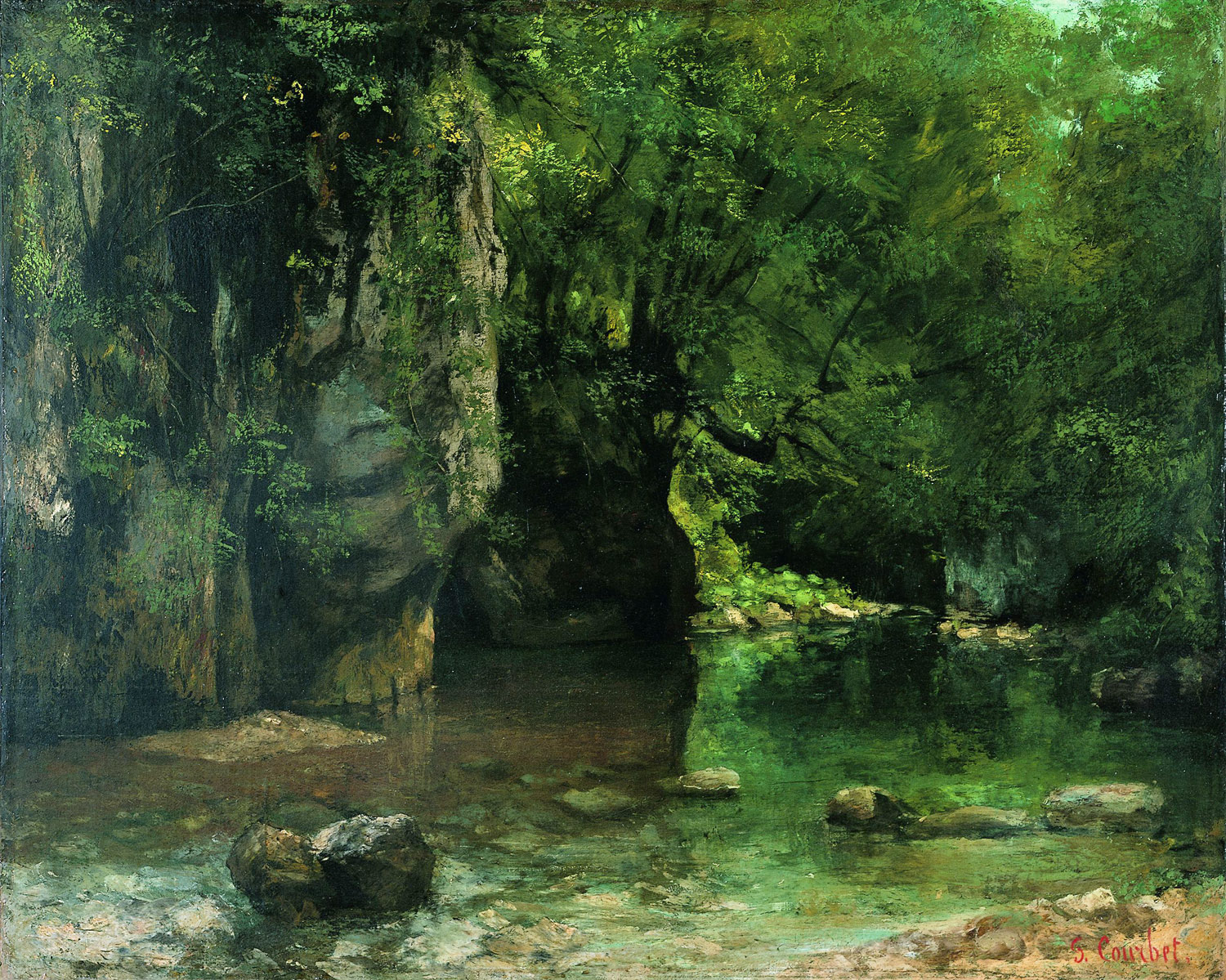
Also, to answer his Romantic elders and contemporaries, Courbet sought to paint the subject of nature in a different light as well.  Similar to Joseph M. W. Turner, Gustave Courbet fixed his efforts in painting nature largely to painting the abstract qualities of nature, or at least, nature for how it really looked and was.  Many of the artist's portrayals of nature are of dark, barren, craggy, and precarious landscapes; he did not idealize a pastoral setting by making it appear perfectly beautiful, like the Romantics.  If a rock was covered in ugly and discolored moss, he painted the rock with the ugly, discolored moss.  Courbet is noted to have said, in direct response to the Romantic technique, "Monsieur Delacroix peint des anges.  Moi je ne peux pas en peindre, je n'en ai jamais vu!" (or, put another way, "Show me an angel, and I will paint one").  The artist argued to have only ever painted what he saw, not what he imagined or believed.  Therefore, his landscape paintings appear different from the idealization of the Romantic tradition.  They are beautiful paintings but more often of muddier streams or cloudier skies.

Wednesday, January 22, 2014

Realism (pt. 7)

Courbet's Stone Breakers is also another of the artist's great works that receives a lot of attention from critics and scholars today—perhaps more so due to the intrigue of its history.  Actually, it is considered as one of the foremost important staples of Realist art and probably even the most definitive example of Realism.
It is a painting of two simple laborers, poor men, wearing rags.  We cannot see the face of either, but one is an older man, one a younger.  Interestingly enough, Courbet has placed them in order, like a timeline.  Perhaps the second image is the boy grown up, or the future generation, all one man.  This faceless worker is forecasted to continue laboring as a poor man for the rest of his life, breaking up stones for railway constructions or whatever purpose.  As viewers we never learn who these two figures are, and we never see them for anything but the labor they are performing.  On Courbet's canvas, these two heads will be turned away from us forever, keeping us from ever knowing them; and that, the artist wanted to observe, is the neglect tolerated by the lower class.  Courbet wanted to loudly observe this, so he painted this unattractive scene on a humongous canvas, 5' x 8'.  During World War II, this painting was destroyed by the Nazis.
It's important to observe the shifting focus onto the lower class at this time as stemming largely from political movements, not just artistic ideas.  Art is mimicking the world around it, not the other way around.  With the 1848 revolutions taking place all over Europe it was no wonder that Realists turned to the subject matter of the common people; their voices were being heard then for the first time in such a public manner.  And around this time the ideas of class systems were being published, most notably by Karl Marx in his Communist Manifesto, produced in 1848.  Courbet began painting this work, The Stone Breakers, just a year after it was published.

Monday, January 20, 2014

Realism (pt. 6)

Perhaps the most prominent artist of the movement was Gustave Courbet, a French painter and radical political idealist.  He took the Realist attention toward the common man to its limits, insisting on using commoners for models in all of his paintings and dressing in ragged clothes himself wherever he went.  His paintings showed honest scenes of how people really behave, such as this image of the Burial at Ornans.
It is the funeral of an ordinary villager.  Unlike El Greco's Burial of Count Orgaz, there are no saints—only commoners—and each is carrying a different expression on his or her face.  The priest routinely reads; the gravedigger seems bored and impatient.  The women mourners don't look convincing, and no one in the painting notices the cross.  Everyone is looking elsewhere, distracted, hardly present at the scene at all.  None of the pallbearers even look at the body.  The sky itself is cloudy and monotonous, the background scenery, uninteresting.  It is quite a boring event, isn't it; and the people in the painting appear bored.  This burial is just another routine event, a regular phenomenon in human life; nothing sacred or majestic.  Courbet's Realism shows the nakedness of human emotions in all of their earthly lack of grandeur.  It may not be very satisfying, but it's true to humankind.  The reality of life, the artist shows, is that the human animal is not saintly, not always beautiful, and is easily distracted from his present surroundings.  This scene is indeed of a burial, but not a very holy one; it's just another death in the life of lower-class society.

Friday, January 17, 2014

Realism (pt. 5)

The crossover of styles can be seen in works like Rosa Bonheur's Horse Fair.  An incredibly talented artist, Bonheur painted stunning works that earned placement into the prestigious salon exhibitions when she was just 19 years old.  She combined Romanticism and Realism in her works and especially liked painting live animals.  The Horse Fair is a scene full of tension and excitement.  It shows a thrilling blend of movement, drama, and realistic composition.  Its subject matter takes from both the Romantic majesty of nature and the Realist depiction of ordinary individuals at a commonplace contemporary event.  Horse fairs were regular occasions in mid-19th century France.  Tradesmen, middle-class merchants, and simple spectators would gather for these marketing fairs.  Bonheur shows with her bold, rich paints the excitement and energy of these fairs and the animals featured in them.  Hers is a masterfully constructed painting that immediately draws our attention into the action of the scene.  The size of the canvas on which it was painted, too, may have something to do with the masterful splendor of such a painting.  This work of art is huge, measuring approximately 8' x 16'.

Thursday, January 16, 2014

Realism (pt. 4)

Homer's paintings are frequently poignant and thematically simplistic.  They lack the grandeur of Romanticism because artistic Realism moved more toward honest, uncomplicated renderings of the simple lives of ordinary people—not like Géricault.  This painting, entitled Fog Warning, is an exemplary model of Realism in art.
This is a very intriguing painting because Homer has here captured an interesting and instantaneous moment of time.  A lone fisherman at sea is rowing farther out after having already reeled in two promising catches already.  By the looks of the two fish in his boat, he is having a pretty good day at fishing so far, but all that is about to change in the flash of a glance.  He turns his head, perhaps at a sudden noise of thunder or else just out of sheer luck, and sees a mighty storm on the horizon.  The hurricane is fast approaching, and one unfortunate boat in the distance already appears in danger, a forewarning of destruction to anyone found too far out in these waters over the next few hours.  We can see, based on his posture, that the man in the boat is paddling out to sea, but once having seen the stormy clouds coming his way, he is about to turn around and row quickly back to shore.  The painting Homer created is of the split second before the fisherman turns his boat around, the moment when he looks and realizes that his time is up for that day; and he must start heading back to safety before it's too late.
The fisherman is a common individual; he is certainly no aristocrat or church deacon.  The painting is a model of Realist artistic theory for this reason.  We're just looking at a normal man, a fisherman, and there is both everything and nothing Romantic about that.  We see a symbol of the middle class in his actual profession and in his actual style of dress, yet we perhaps do not view a scene like this without remembering what other common men were simple fishermen before their lives turned around dramatically by one Man to becoming "fishers of men."  In that sense, you can find some small elements of Romanticism within some Realist works.

Wednesday, January 15, 2014

Realism (pt. 3)

With the rise of industrialism in the Victorian Age, art changed subject matters from the glorious to the ordinary.  The art movement known as Realism spawned from such a thematic turn.  Images of the common man and everyday life, as we saw with Thomas Eakins' The Gross Clinic become increasingly prevalent during this time.  Young artists in France started rejecting both Neoclassicism and Romanticism due to the industrial changes occurring all around them.  They focused on peasants, factory workers, and common scenes of otherwise insignificance.  This new art form, Realism, represented everyday scenes and events as they actually looked.
The American painter Winslow Homer was a Realist artist who tended to focus on marine landscapes.  In the aftermath of the American Civil War, Homer painted a thoughtful scene entitled Veteran in a New Field.
The person we see here is an ordinary man, not a revolutionary, aristocrat, or priest.  In fact, he is so ordinary that nothing of his features stand out to us, the viewers.  He's got his back turned to us, and we can't see his face.  We can tell, however, by his clothing and the labor which he is performing, that he is a lower-class individual, dressed in farmer's attire, reaping crops for the harvest.  The scene is a humble one, like Millet's The Angelus, but no hopeful, inspiring, spiritually encouraging church steeple can be seen on the horizon.  There is no horizon.  Our lone farm worker is lost in a seemingly endless field of tall crops, and we cannot see what lies ahead.  The unidentified character keeps his head down, focused on his melancholy work.  He's holding an old-fashioned scythe, which no doubt conjures images of another Reaper who famously holds a similar tool in his deadly grip.
After the profound loss of life the United States witnessed during its Civil War, paintings like this one by Homer brought a sentiment of somber reflectiveness on the past and solemn assessment of the future.  America was in a period of Reconstruction.  After the assassination of President Lincoln, the South was more harshly dealt with as far as reparation demands extended.  The nation was falling into a Gilded Age of financial corruption and economic instability that would, in jest of the national single-partisan political period of half a century earlier (the so-called Era of Good Feelings), later be nicknamed "The Era of Good Stealings."  But for the veteran, the common soldier who had witnessed the bloodiest conflict in American history, post-war assimilation was a much deeper matter than money.  Homer's painting of the "Veteran" carries weighty, psychological implications for the soldier returning from war to the home that will never be the same again.  The hacked crops sprawled out on the bottom half of the work make sober reference to the carnage seen in the war; the veteran farmer's feet are buried in it.  He has returned from the battlefield to a new field that is, in its own sense, no less full of death.  His scythe, as I mentioned, is a symbol of death, and the rising wall of crops blocking our vision ahead connotes an uncertain future for the common man living in America.  But perhaps what is most poignant about the scene with the veteran is that he is alone, unaccounted for, as veterans sadly so often have been over the course of U.S. history.  This common farmer's plight is the stuff of Realism and the uncovering of the middle class struggle in the art world in general.

Tuesday, January 14, 2014

Realism (pt. 2)

In 1839, something happened that would change art forever.  If you ask me, the invention of the camera probably marks the key turning point in the history of art.  When considering in our culture today more contemporary art forms, such as Modern Art, it's often difficult to understand how such a style could have evolved from the long line of artistic traditions seen in a study of Western art history.  One simple answer is that photography made painting obsolete; but that's not the full picture, is it.  In 1839, when Louis J. M. Daguerre devised a method of exposing light to a silver coated copper plate to make a photographic image, the art world did not immediately change.  Realism, though affected by the camera, was already in progress before the invention of the Daguerrotype; however, this landmark discovery would definitely have a most direct and primary effect on later art movements.
It's kind of funny and sad at the same time, but it wasn't long after the camera was invented that one of its major functions became the production of pornography; however, this invention carried far greater potential in areas less squalid.  The importance of such a discovery seemed to alter the historical flow of time.  News could be spread faster; images could capture scenes in more accurate ways than art.  Photography meant someone could "live" forever.  But as honest an image as the camera could provide, much of early photographic images were used for propaganda, very little different from art.  Photographs, among other things, were used to make careers, even political careers.
Matthew Brady was hired as Abraham Lincoln's official photographer similar to the way in which artists had been hired in the past as court painters.  Brady's objectives were the same as those earlier artists: to make his subject look good.  In this photograph of President Lincoln we see similar artistic techniques to Jacques-Louis David's portrait of Napoleon in His Study.  You will recall that, in that painting, Napoleon was made to look tall through use of vertical line.  This image does the same.  We have to look up and down across the entire height of the picture to completely appreciate the man's full stature.  A column in the background (placed in the same location as in David's painting) adds to this sense of vertical loftiness.  (And of course Honest Abe was rather a bit taller than Napoleon—haha, I just had an image of Lincoln on the basketball court with Bonaparte, making slam dunks over the little dictator and blocking every one of his shots—hehe…okay, back to the photograph).  Also in this portrait we see President Lincoln with a small stack of books on a table beside him, much as David painted Bonaparte in his study with a bunch of pamphlets and documents.  Lincoln's left hand rests on a Bible, demonstrating him to be a man of moral principles and honorable character.  You can see how even early photography was used for propaganda purposes.

Monday, January 13, 2014

Realism (pt. 1)

In the mid-19th century, Royal Academies in Paris and London held yearly exhibitions to encourage interest in the contemporary arts.  Academy members could showcase their art during these exhibitions, or salons, as they were called.  Salons were important social events where reputations were acquired.  Scientific inventions, art, new fashion design, and other creative works could gain worldwide notoriety through being featured in these exhibitions.  It was a kind of world's fair, and artists who were good enough to enter into the salons held the possibility of making a great amount of money in selling their paintings to patrons and visitors.  Contemporary European art now had its own quasi-exclusive club that acted like a stable home for its consistent production, development, and growth.
In 1834, the British House of Parliament building was destroyed in a fire and was consequently under reconstruction over the next four decades.  As you can imagine, it was quite a historic event.  To commemorate this event, the burning of Parliament, J. M. W. Turner exhibited paintings of the scene which he made from memory (Turner was an eye-witness to Parliament's destruction).  He chose to paint the scene in a blurred mass of sketchy brushstrokes, done stylistically in order to produce the effect of the smoky air on that day.  His painting did not contain much detail or photorealism, and it was in turn highly criticized by the Royal Academy.  And so now we begin to see how many famous artists started out as Royal Academy salon rejects.
It's easy to critique paintings like Turner's Burning of the Houses of Lords and Commons because it looks unrealistically and hastily fashioned.  Critics of the day would argue that this artist, because of his style, lacked the kind of higher-scale talent required to enter into the prestigious Royal Academy salons, but let us not forget that these painters were all Classically trained.  We have looked at this painting as well as Turner's Snow Storm image of a Steamboat off a Harbor's Mouth and perhaps have thought the artist's style unique enough, but a look at his earlier work will remove all doubt that he was not perfectly able to create photorealistic images on his canvas.  In paintings such as this, his first exhibited artwork, we see just how masterfully the artist's brushstrokes and color palate could envision a stunningly lifelike image of nature as it really appears.  Artists like J. M. W. Turner chose to paint in other styles for different reasons—to experiment with new ideas or to express inner emotions—not because they weren't able to paint Classically realistic forms.