Tuesday, August 27, 2013

Still Life (pt. 1)

The Baroque age in art also saw the surge of the Still Life.  A still life is a painting of an arrangement of inanimate objects usually showcased on a tabletop or other flat surface in an enclosed space.  We have all seen paintings like this before and may have thought them simple or even boring enough, but "surely all this is not without meaning."
In this case, the "subject" is whatever is pictured in the image.  The subject of a still life can be a glass cup, a vase of flowers, a book, a skull, or (most popularly) an assortment of objects.  To the untrained eye these items can at first appear random, but as you will see, some still life paintings ambitiously tackle more subject matter, artistic form, color scheme, and picturesque detail than landscapes or historical paintings.
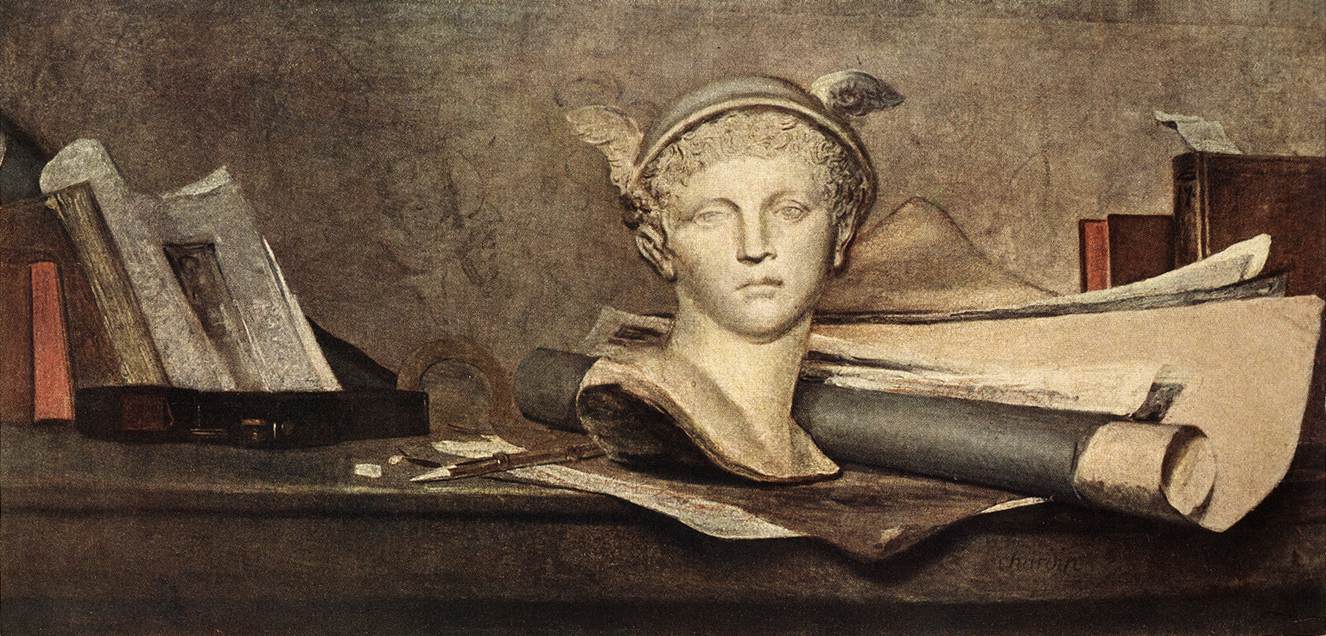
Still lifes—and I distinguish: the plural of "still life" is not "still lives"—can offer a unique blend of genres for both artist and viewer.  By simply painting immobile objects on a stationary table or drawer-top, the artist can have the chance of practicing his trade on something decidedly easier than, say, a portrait, where a live sitter is involved (who coughs, moves, easily becomes bored, and can distract the painter from his duty).  In the case of a still life, the objects are all completely motionless; the artist can take all day, or even a year—it matters not: the objects will still be there.

Thursday, August 15, 2013

Dutch Baroque (pt. 12)

This is another painting from a kind of closet view, called The Love Letter.  There are two women in a room: one is a servant, the other is receiving a letter.  The woman with the letter looks at the servant, who smiles back.  A story is being told here in a very creative way.  The paintings on the wall might hint to us that the writer of the letter is away at sea.  The woman's expression implies that it is an important letter being given, and the title denotes a sentimental interpretation of that.  The servant's expression also seems to say that it could be a letter from a lover, and the fact that the lady is playing the lute also demonstrates that she is a romantic woman.  But all of this is seen from afar.  The viewer (that's us) is in a dark closet, but the two women are well-lit in the room in front.  Here, nearly half of the painting is concealed in darkness.  Once again, the black and white tiles on the floor show linear perspective and lead us into the action of that room.  We are drawn to the event taking place, but we remain far away in this private chamber.  Perhaps it was to give us the sensation that what we are seeing is completely real and candid, not prearranged and staged like other portraits of the time.  Perhaps he wanted to go a step further from Hals and display the true human emotions of individuals when they know that no one else is watching.  Why do you think Vermeer chose to paint from this perspective?

Monday, August 5, 2013

Dutch Baroque (pt. 11)

Known to be the artist's own personal favorite of his works, this painting is enigmatically titled The Allegory of Painting, and it is a prime example of Vermeer's stylistic approach towards painting.  The room is the main attraction, with dramatic lighting coming from a window on the left-hand side, allowing the viewer to begin with light and read over, from left to right, the images to follow (the painter of which is last).  Props in the room such as chairs, tables, tapestries, books, cloths, a mask, and an overhanging chandelier create an interest in the viewer towards this mysterious setting.  The tiles on the floor further act to bring us into the painting because of their stark three-dimensionality.  The tiles represent textbook one-point linear perspective (which we learned about in the Renaissance).
The intriguing aspect of this painting is of course its elusive title.  We see a woman posing in Greek literary attire for the portrait artist, whose back is turned to the viewer.  We can see neither his face nor much of the painting he has begun.  Also, where are the paints?  The artist has no palate.  Is he, then, really painting?  What is actually going on?  Taking a step back—which the perspective of this distant work is quite a few steps back—we cannot ignore the draping tapestry that covers almost a third of the painting.  It has been pulled back, almost as if the audience were secretly peering into a private chamber from behind the curtain.  Some hidden reality, some deeper truth is being shown here by the curtain being pulled back, and the riddle goes unanswered.

Friday, July 26, 2013

Dutch Baroque (pt. 10)


The Astronomer.  This one is maybe my favorite.  Everything about this speaks philosophy and the work of the person—not the person himself.  Even his full face is hidden from view, turned towards his endeavors in studying the universe.  He reaches out toward the globe, the spherical representation of knowledge, with an opened book placed in front of him on the desk.  More books fill the shelf in the back, and pinned to the front of the shelf is a diagram of geometric lines of radial symmetry.  He is, as most of Vermeer's figures, near a window.  The lighting in the room is warm, and the glow from the outside sunlight falls onto the astronomer as a kind of symbolic display of God's radiant presence in his studies of the cosmos.  It was around this time that scientists Johannes Kepler, Galileo, and Sir Isaac Newton were making breakthrough discoveries in the study of nature and the order of the universe.  Even these scientists, and especially these scientists, believed in the existence of a Supreme Deity, God, a Creator and Sustainer of the heavens.  Recently Dr. Stephen C. Meyer spoke on this subject in an interview, stating, "The founders of early modern science…all not only believed in God but they thought that their belief in God actually made it easier to do science."

Tuesday, July 23, 2013

Dutch Baroque (pt. 9)

Next, let's look at Jan Vermeer.  It should be said that his are among the most coveted paintings in the world because they are so rare.  His style, too, however, is one of impeccable exactness.  I heard someone at an art museum lecturing a while back, and he was arguing to his class about the quality of touch in painting.  All other techniques, he said, can be copied and mimicked.  Colors can be reproduced, tone reused, shapes obviously can be refashioned on a flat canvas, the dimensions of a painting can be duplicated to an exact facsimile—the images are there to be painted again; however, he said, the one thing that cannot be replicated is the sense of personal touch in the artwork.  You may have Vermeer's colors and tools, but you do not have the exact lightness of fingers that he did in dabbing finite brushstrokes to his paintings with the delicacy of hair-splitting precision and, more importantly, you do not have the precise velocity of his brushstrokes to produce the tone of harshness conflicting with softness that is present in some of his most famous works.  This is the irreplaceability of Vermeer's work.
Vermeer often liked to paint pictures of everyday life, akin to the now established Protestant tradition of genre painting.  He painted portraits in which the interiors seemed to have greater importance over the figures, and he is known today for his lush interiors more so than for his actual portraits (with the exception of the above, the celebrated Girl with a Pearl Earring).  Most of his paintings are of the same room, actually, which presents an interesting microcosm to the viewer.  "All the world's a stage" was penned by Shakespeare some sixty years earlier.  "And all the men and women merely players:" the people in Vermeer's works are often presented as less important than the light and textures of the stage picture he displays.  In order to see the consistency of his approach to his subject matter, it is beneficial to look at several of his works.  In the spirit of true, hardworking diligence, we'll just look at a few.

Monday, July 22, 2013

Dutch Baroque (pt. 8)

And thus we come to the late works of Rembrandt before his death, where his style changed from specific attention to detail to less and less fully developed, concrete forms.  A kind of social outcast, financially bankrupt, and alone, Rembrandt's later self-portraits display him as the saintly martyr to society which he viewed himself as.  When given his last public commission, then, to paint a work for the newly constructed city hall, the artist let his disdain and bitterness towards society come out in The Conspiracy of Claudius Civilis, which was rejected and sent back to Rembrandt, who then destroyed most of it for resale (the image we see today is only a fraction of the original painting).  Soon after, the artist grew so desperate for money that he was forced to sell his wife's grave.
Here we see a chapter from the account of Tacitus' Histories being portrayed: the meeting of the lower-class conspirators, led by Claudius Civilis, in forming the Batavian rebellion (ancient Dutch) against the Romans in 69-70A.D.  This is how the Dutch civilization was born; every citizen in Amsterdam would know it.  What could be more appropriate for city hall, remodeled to celebrate Dutch society?  But look at the painting's composition.  It looks more like a rough sketch than a finished painting; the glorious rebels look like barbaric and haggard old ghosts—or are not given clearly distinguishable faces at all.  The lighting of the work is impossibly contrived, and the color scheme is a bland blob of browns spilling with repressed reds and sickly yellows.  The lines deviate and the shading varies in splotches.  The individuals' faces look like cartoon drawings, and the leader, Claudius himself, comes across as a deformed figure of feigned political and military authority.  His facial wound from battle is cast in full view; he is a one-eyed Cyclops of a man, ugly and animalistic.  Why did the artist choose to paint it like this?  It was his last chance to impress his Dutch audience, but Rembrandt didn't care about that.  He had always painted his own face with his nasal wart and unattractive wrinkles showing.  How much more, then, would he exploit the lesser qualities of his peers who had lowered him in their minds to such meager social standing?  This, in turn, is Rembrandt's scathing review of his peers.  By painting the founding of the Dutch civilization, he attempts a comprehensive portrait of the Dutch people themselves.  In a way, this is Rembrandt's final portrait, and it is a portrait of his fellow townsfolk in all their broad imperfection.  A bitter old artist gets his revenge against a society that had cast him out and left him alone, like the windmill on the hilltop from the painting he had done twenty years earlier.  And that is how Rembrandt died.

Thursday, July 18, 2013

Dutch Baroque (pt. 7)

In 1642, Rembrandt lost his wife (presumably to tuberculosis), and in the following months the artist began the practice of taking long walks in the country alone to help overcome his grief.  During this time he painted The Mill.
This painting once again carries out the invisible emotions in a very visibly symbolic way.  Solitude and loneliness are themes of this work.  A solitary, old windmill stands totally alone in the center of the painting, facing the light but haunted from behind by enveloping dark clouds that foretell death and devastation.  The people in the painting are all weary travelers stopping by the lake to gain refreshment from the water; but is anyone truly ever rejuvenated?  (This is certainly no Fountain of Youth.)  But for all its brooding drama of light and dark shadow and sky, the setting is quite calm and quiet, peaceful and tranquil in a transcendent way that only a person who has ever gone through such deep sentiments of sorrow can understand.
Rembrandt was widely known during this time to be a poor manager of his money.  He was a prodigious spender and collector; he would collect prints, portraits, clothing, and the like for his work, but it eventually led him to becoming broke.  There are stories of his students painting guilders (coins) and putting them on the floor to see if Rembrandt would pick them up.  His first wife—his only wife, I should say—was rather a well-to-do woman, but the only way he could maintain an entitlement to her fortune after she died was to never remarry.  So Rembrandt went on to take mistresses without marrying.  It was known that he was having an affair with his maid in the years following his wife's death because they were having children together before long.  The maid was excommunicated from the Dutch Reformed Church; Rembrandt was not.  This is because Rembrandt had never become a member of the Reformed Church and therefore maintained immunity from the practice of church discipline.  He attended but never joined the church, and it has been argued that this was because Rembrandt was an Arminian.  At first widely successful, the artist's high reputation gradually diminished for these reasons—kind of like how nobody really cares about Tiger Woods anymore because of the recent scandal involving his more disreputable personal life.