Wednesday, May 29, 2013

Italian Baroque (pt. 6)


I feel as though I have already provided sufficient depth of inquiry (at least for the time being) on the subject of paganism as an artistic element in Westernized or Christian art, literature, and especially poetry.  C. S. Lewis has written most extensively on the topic of Myth's power to encompass both the "sacred and profane," the divine and base, the Christian and pagan.  However, much of this writing was done in my other, literary blog, and so I shall allude quickly to it again here now with this next artist, Titian.  Let us observe the Bacchanal.
Remember Titian?  He was the artist who painted The Concert and the Venus of Urbino.  He alludes often to Greco-Roman ideals in his paintings, but that does not make them pagan, as is the case here with the Bacchanal of the Andrians.
A bacchanal denotes a raucous party held by Bacchus, who was the pagan god of wine in Ancient Greek mythology.  As tradition follows, these pagan celebrations were of the wildest nature in perhaps all literary history, almost always including drunken orgies and other rowdy "romps," as C. S. Lewis famously termed them in his Chronicles of Narnia.  In his time the professor of Medieval and Renaissance Literature at Cambridge University, Lewis saw prevalently in his studies of Malory, Chaucer, and other subjects of Medieval study the infusion of pagan aspects into Christian stories.  Perhaps most notably this begins with Beowulf and continues on to this day with books like The Lion, the Witch, and the Wardrobe.  Lewis believed that paganism and Christianity were in a way connected.  How else does one explain the prevalence of pagan elements in otherwise predominantly Christian texts and paintings during this time?  Western literature has often borrowed from the pagan as a sort of foundational, ancestral root-point from which could stem the holier, more definitive doctrines of Christendom.  Lewis suggested that the idea of Bacchus, the god of wine, was "the first, faint whisper" of something that Christianity later became literally.  Bacchus represents wine in a mythical sense where Christ turned water into wine in a literal sense.  The connections spring from this line of thought.  With this view in mind, we ought not be surprised to see paintings like Titian's Bacchanal here appearing during the Counter Reformation (the Catholics' response to the Protestant Reformation).
Though this painting features lewd images not literally promoted by the Catholic Church, this was nonetheless a painting to convey Catholic messages.  The allusion being made here is to something larger than the church itself.  It harkens back to the archetypal celebration held in tradition from the earliest ancestors of Ancient Greece.  The same idea is being communicated, just in different rites, through the passage of time.  No longer do people strip nude and get drunk on wine to party, but the partying still occurs, to put it simply.  Joy is felt through different means, but joy still exists, timeless joy that transcends contemporary custom.  Titian's painting is one of joy and celebration, hinting at the vivacious splendor and gaiety (…ha) of the Catholic Church at this time as well as the happy welcome home party awaiting any Catholic converts (recall Murillo's Return of the Prodigal Son).  Here we see some very strange things going on, but the core idea behind it is one that is still familiar to us today as it was during the 16th century.  It is the timelessness of the Greek myth, the Greek culture, often held as utopian, which resonates most powerfully, being most ancient.  Being expressed in this painting is the fundamental concept of joy, joy which is implied to be available on a divine level for those who would join the Holy Roman Empire.
It's often a difficult connection to make.  One almost cannot imagine a painting like this one or Botticelli's Birth of Venus being put on display in such a celibate and legalistic place as the Vatican.  The reason is that the actual, physical practices of the paintings are not being regarded (i.e., the nudity, drunkenness, and…you know…whatever else is going on here…); rather, the age-old ideas being expressed by those practices is the core of these works of art.  C. S. Lewis did the same thing in The Chronicles of Narnia when he added such scenes of "romping" and partying, often including literal references to the Greek and Roman gods.  He is not suggesting we all participate in specifically pagan rituals.  It is to say that Christians experience joy as well—that joy is not a monopolized experience to be held by one people, but that someone else can come along, take that concept, and make it his own.  Lewis made the pagan bacchanal celebration almost Christian by placing it under the very Messianic character of Aslan.  The ancient myths of parties were fulfilled in Aslan, and the reference to the classical myths merely work to show the historical totality of the concept.  Here, too, joy is tacked under the name of the pope in the Vatican to assert the joys of embracing Catholicism.
If this doesn't make sense, don't worry; we will get more into it later on.  As we will see, there is some trend for whatever reason for art through the ages to consistently revert back to Greco-Roman ideals, as if to idolize that time period and that historical culture.  Greek myths, Roman architecture, etc. will appear again and again nearly as often as Keira Knightley appears in movies these days (seriously, she's in all of 'em).

Monday, May 27, 2013

Italian Baroque (pt. 5)


Bernini's other famous work is his more controversial sculpture of The Ecstasy of St. Theresa.
The story of St. Theresa was that, in a vision, an angel pierced her heart with a fire-tipped golden arrow, symbolizing God's love.  In the statue here, the angel and the saint are carved in white marble, and the background is golden rays coming from above.  The scene is lit overhead by a window built into the Vatican wall.  The figures appear to be floating freely in the space, don't they?
Much has been made of the artwork's sexual undertones.  The arrow is at first an obvious phallic symbol, targeting a swooning female whose facial expression indicates one of euphoria.  And although we cannot see inside of this cold, statuesque Theresa, Bernini put his sculpting genius on display with his treatment of this subject.  We do see the ecstasy of St. Theresa, not merely in her face, but in her entire form, covered as it is in wavy, flowing robes.  The drapery of the nun is surging with energy and motion that indicates the electric activity being felt on the inside.  Bernini takes a subject of spirituality and infuses it with more realistic, human, almost base descriptions, as if to convey the divine love of God as a very carnal, sensual phenomenon.  If you would ask how to interpret such a crossover, the resulting discussion would fill many more pages which I will not trouble to venture down at the moment.  It is possible, however, once finished with our overview of art history, to then go back, ask questions, discuss, and focus in on the specifics that were left behind.  For now, we should press on.

Thursday, May 23, 2013

Italian Baroque (pt. 4)


But now for the definitive Italian artist of this period in art history: Bernini.  It was Bernini who, together with Boromini, defined Baroque art.  The two hated each other, but they found themselves needing to work together on occasion.  Bernini was skilled from youth.  When he was just eight years old he was brought before the pope to do a sketch.  His career flourished in his later life, but his personal happiness was questionable.  That Bernini's wife had an affair with his brother is one of the most scandalously famous of the artist's tribulations in life.
Bernini's David was perhaps his masterpiece.  We have already looked at two other famous David statues.  One took place before the action of killing Goliath (Michelangelo's), where the young boy is looking ahead at the giant, preparing to approach and kill the Philistine.  The second (Donatello's) showed the scene after the slaying of Goliath, with David casually resting on top of the Philistine's dismembered head.  Bernini's statue captures the action during the actual fight scene.  Doesn't get more dramatic than this.
The theme of the sculpture is movement.  David's body is twisting in space, ready to hurl the stone at Goliath.  His determined facial expression and flexed muscles demonstrate his intent on killing the enemy of Israel.  The dramatic action makes you visualize the scene.  The statue is also especially circumferential; the viewer can follow the action around the statue a full 360 degrees.  David's body is bent such, and the sling twists around with his flowing clothes.  Bernini's David is like the Discuss Thrower of Ancient Greece, emphasizing action and excitement.  And just look at the determination on David's face.

Monday, May 20, 2013

Italian Baroque (pt. 3)


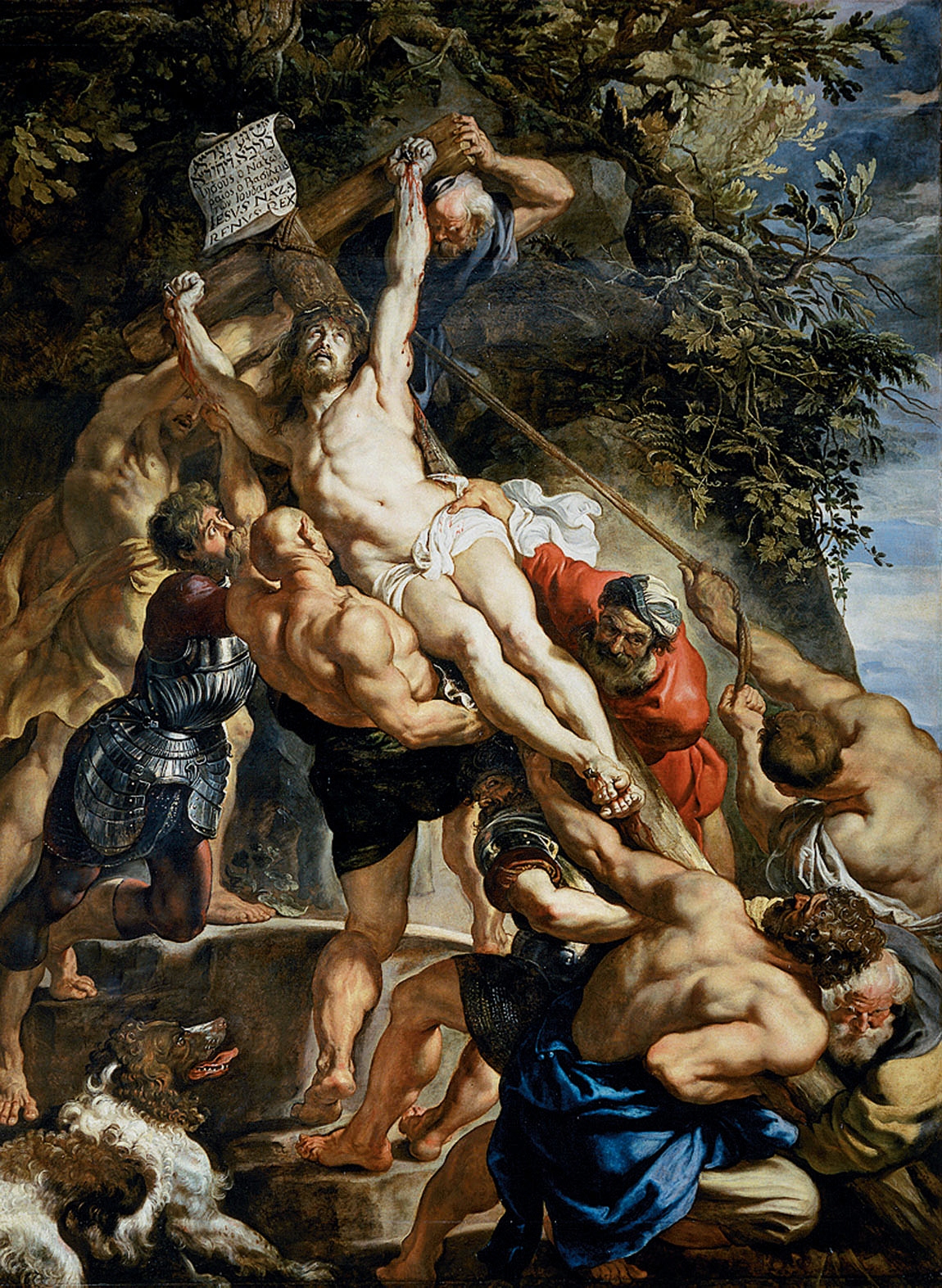
Without a doubt the Flemish master of the time was Pieter Paul Rubens.  Just look at his famous painting The Raising of the Cross, painted in 1609-1610, which was in many ways an emblematic representation of the Catholic Counter Reformation.
The dramatic movement dominates the painting.  There is a stark diagonal line stretching across from the top left to the bottom right of the frame, and almost every character in the scene follows that diagonal, directing our eyes up and down through the scene to see everything that's going on.  I count nine burly, muscular men that it (apparently) takes to lift the cross.  Is this an exaggeration or do you think it would literally take nine of the strongest-looking men to lift Christ on the cross?  I personally believe it would fit in with the style of the time to assume this is an embellishment, a demonstration of the incredible weight of Christ—not physical weight, but the spiritual weight, the weight of the subject on Man's heart.  The Crucifixion is a subject not to be handled lightly, seems to be the message here.  Christ, the brightest and holiest figure in the painting, is shown here to have died a most dramatic death.  Attention and respect is owed to Him for what He did.  You can go to church to pay homage to the Crucifixion—the Catholic Church.  This is again almost advertisement for Catholicism.  Notice the dog, again the symbol of loyalty and faithfulness, on the bottom left-hand corner.  Be faithful to the Catholic Church.
And this is Daniel and the Lion's Den, another famous painting by Rubens.  The lions in the painting look absolutely ferocious, and the scattered bones of a presumably eaten human at the bottom of the picture add to the sense of danger and imminent death.  It is only people who remember the story of how the Lord shut the lions' mouths that remember Daniel's escape and survival through such an ordeal.  Daniel, however, looks less than confident in his God's ability to save, but he is praying, hands folded and looking up to Heaven for aid.  I always thought it looked funny that he has his legs crossed, like he's sitting casually on the sofa, reading the morning paper or something.

Friday, May 17, 2013

Italian Baroque (pt. 2)


Now let us examine the art of the artist Caravaggio—"an absurd name…of course."  When studying the works of Caravaggio, it is paramount to know the term chiaroscuro, which refers to the arrangement of dramatic contrasts of light and dark value, as it dominates this artist's body of work.    Caravaggio did not invent this element but made it his own through stylistic exaggeration to the point of tenebrism.  And what religious event better to paint that involves dramatic lighting than the Conversion of St. Paul (also the title of this next work)?
You will all remember, naturally, the story of Saul of Tarsus' conversion to Christianity, becoming the Apostle Paul, on the road to Damascus.  A bright light shone from the heavens that blinded Saul, and the Incarnate Christ appeared to him with that earth-shattering interrogative, "Saul, why are you persecuting Me?"  Caravaggio takes on this subject with startling (almost offensive) originality.  All we see are Paul, his horse, and the servant.  There is no backdrop to distract the viewer, giving the full attention to the scene at hand.  But how is this scene constructed?  The horse takes almost the full breadth of the work's scale, and Saul lies at the bottom, seemingly more in danger of being imminently crushed by a horse's hoof than anything else.  Saul's arms are lifted in the air in a helpless and dumbfounded gesture.  He is totally enwrapped in the moment, as I suspect anyone would be in the middle of a meeting with God.  However, perhaps one of the most puzzling aspects of the painting is that it contains no image of God…or does it?  Remember back to the Northern European Renaissance art that showcased candles and lights as symbols for God's presence.  Inasmuch as the lighting here is dramatically prevalent throughout the painting, so this painting overflows with divine presence.  We cannot even see the backdrop, it is so dark when compared to the illumination of the scene.  Caravaggio emphasized light in his paintings.  He would literally shed light on figures, display the details of their faces and expose their imperfections.  This demonstrated the painter's commitment to render a more realistic and life-like image.  Some paintings were refused by the church officials who commissioned them, since these officials did not like that Christ and the saints were shown in untraditional ways.  These saints were supposed to look supernatural and holy; they were not just anybody!  (Says the Catholic Church).
One other artist whose technique of employing chiaroscuro that, I think, matched Caravaggio's impressively is the artist Gentileschi, who was also the first woman to significantly impact Western art.  She painted Judith and Maidservant with the Head of Holofernes, a tale from the Apocrypha.
Once again, we can only barely see the scene.  Here it is quite literally taking place by candlelight, and only the figures, the desk, the back curtain, and the hideous, beheaded figure of Holofernes are discernible.  This is quintessential chiaroscuro at its most extreme.  Things become more dramatic in the dark, do they not?  The mind plays tricks on you in the dark.  The light, small and weak though it is, appears to shine brighter given the darker surrounding.  A ghostly aspect is applied to all objects at nightfall.  Hawthorne wrote about this much later.

Thursday, May 16, 2013

Italian Baroque (pt. 1)


Now let us glide over to Italy and Flanders to study the art which was being produced there during this time.  Italy and Flanders remained Catholic after the schism of the Reformation, and they were a leading center for the Counter Reformation, which was an effort by the Catholic Church to lure people back to regain its former power.  We have already been seeing this.  Murillo's Return of the Prodigal Son as well as even Velàzquez's Surrender of Breda are works exemplifying the style and tone of the Catholic Church's Counter Reformation.  This type of artwork supported the Catholic Church and discouraged heresy.  The church sought the newest and best artists to bring people back.  Many artists were sent to Rome to create these works that would restore the religious spirit in the Western world.  And so we look to Rome, Italy, and Flanders to observe what was really the headquarters of the Counter Reformation.  We already looked at a couple or more works from there when we looked at Mannerism.
The art of this time, as we know, was characterized by more action, increased excitement, vivid, dramatic lighting effects of contrasting lights and darks, and motion and emotion; however, the architecture also underwent stylistic changes.  The Roman church Il Gesú features huge, sculptured scrolls which magnificently exemplify Baroque style.  The Baroque period had a distinct architectural style.  It introduced convex and concave push and pull.  The interests were in movement, contrast, and variety.  It contained great importance of feelings expressed, and it brilliantly captured drama.  It has been said that Baroque art did not so much focus on beauty.  In actuality, the artists overwhelmed and quite possibly confused their viewers with a blended world that mixed reality and imaginary imagery.  This is the façade of the building (a façade is simply the front of any cathedral structure).

Friday, May 10, 2013

Spanish Baroque (pt. 4)


Also appearing in Spain during this time were the works of Jusepe de Ribera, who also toured and worked in Italy.  This painting, if not his crown achievement, is at least well-regarded in the art history circle of scholars and art critics.  This is The Blind Old Beggar, a painting based on a Spanish novella that had been newly published at that time, called The Life of Lazarillo de Tormes and of His Fortunes and Adversities (published in Spanish).  In the story, Lazarillo is told to have come from humble beginnings.  As a boy, he was given to a blind man for adoption.  Their relationship was not a good one, and the boy was unhappy.  He eventually adopted the old man's shrewd cynicism, despite his extreme dislike for his guardian while serving under him as a child.
In Ribera's painting, the background is dark, perhaps to signify the pair's unpleasant relationship.  The boy stares out from the painting with sharp eyes as if he is looking at the world cynically, like the old man.  The boy's eyes are probably the most moving aspect of the work.  The painting uses dramatic lighting and realism to paint an old man and a young boy standing together in the shadows.  They juxtapose their surroundings, and they juxtapose each other.  Their faces contrast against the darkness; the old man's wrinkles contrast to the young boy's smooth skin.  Everything, it would seem, is at disunity, two or more worlds clashing together in tension and unrest that makes the painting so dramatic.  Again, the boy's facial expression and the look in his eyes, while culminating the emotion in the painting, is, I would argue, one of the most profound images in the history of art.